Insights from 80 years of clinical practice by Prof. Tony Attwood and Dr Michelle Garnett
Part 1 of the article series on the Biomarker Workshop 2025
For a long time, autism and ADHD were regarded as mutually exclusive diagnoses. Only with the DSM-5 revision in 2013 was it recognised what those affected and experienced clinicians had long known: the two conditions can – and frequently do – occur together.
Research in recent years has impressively confirmed this clinical observation. The combination of autism and ADHD is so common that a term of its own has become established for it: AuDHD.
The figures speak for themselves
Current prevalence rates show the extent of the overlap:
- Autism: 1 in 36 people (CDC, 2023)
- ADHD: 1 in 10 people (Danielson et al., 2018)
- AuDHD: 40–70% of autistic people also meet the criteria for ADHD
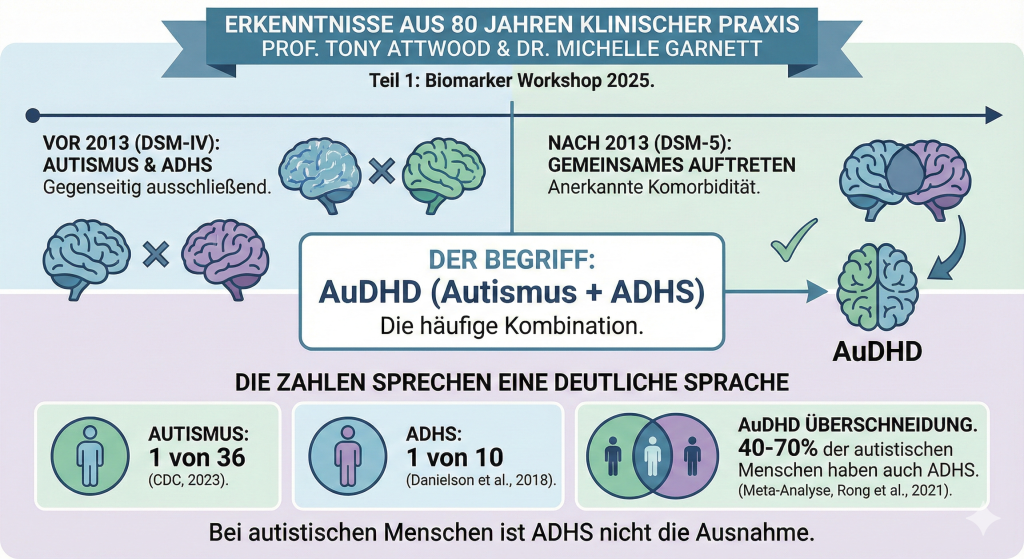
This last figure comes from a meta-analysis of 63 studies (Rong et al., 2021) and makes it clear: in autistic people, ADHD is not the exception but almost the rule.
What does it mean to have AuDHD?
People with AuDHD often experience an inner tug-of-war between opposing needs and tendencies:
- Making spontaneous plans (ADHD), but becoming very upset when these plans are disrupted (autism)
- Having difficulty organising the day (ADHD), but having a strong need for order (autism)
- Struggling to be on time (ADHD), but being annoyed when others are a few minutes late (autism)
- Hyperfocusing on many different topics (ADHD) while at the same time maintaining long-term special interests (autism)
- Seeking new experiences (ADHD) while at the same time needing predictability and sameness (autism)
“A Ferrari with bicycle brakes”
“It’s not that I have a deficit of attention. I take in everything. I pay attention to everything. If anything, it’s an attention overload. The deficit lies in working out what is important and getting it done on time. The part of the brain responsible for prioritising, integrating and sorting all the incoming information is just pretty bad at its job. My brain is a Ferrari with bicycle brakes; it has no filing system.”
— Hannah Gadsby, “Ten Steps to Nanette”

This quote from the Australian comedian Hannah Gadsby, who is herself autistic and has ADHD, aptly describes what many people affected experience: it is not about a lack of attention, but about the difficulty of filtering and prioritising the flood of impressions.
The neurobiology: different patterns in executive functions
Research by Craig et al. (2016) shows interesting differences between autism and ADHD in executive functions:
Only in ADHD, not in autism:
- Difficulties with response inhibition (impulsivity)
Only in autism, not in ADHD:
- Difficulties with flexibility
- Difficulties with planning
In people with AuDHD, both patterns can occur at the same time – which explains why they need structure and planning on the one hand, yet struggle to put them into practice on the other.
The strengths of AuDHD
Attwood and Garnett emphasise that the combination of autism and ADHD can also give rise to unique strengths:
Innovative and creative problem-solving: Combining the fast, expansive thinking patterns of ADHD with the autistic capacity for deep, sustained attention to detail.
Hyperfocused engagement: Once interest is sparked, the strong capacity for hyperfocus leads to comprehensive knowledge and expertise.
Persistence and adaptability: Autistic determination combined with the ADHD ability to embrace change and new ideas.
Passion and intensity: Deep passion for a subject (autism) combined with the energetic drive of ADHD.
Heightened perception: Both conditions bring heightened sensory sensitivity, which can lead to special abilities in music, the visual arts and scientific research.
Conclusion: discovery rather than diagnosis
Attwood and Garnett suggest using the term “discovery” instead of “diagnosis”. A diagnosis is often the beginning of a new self-understanding – not the end of a search, but the start of a deeper understanding of one’s own neurology.
Temple Grandin puts it in a nutshell: “If the world was left to you socialites, we would still be in the caves talking to each other.”
Find out more at the Biomarker Workshop 2025
On 11 December 2025, Prof. Tony Attwood and Dr Michelle Garnett will present their keynote “Beyond the Stereotypes: Biomarkers for the Hidden Presentations of Autism, ADHD, and Anxiety” at the Biomarker Workshop in Zurich.
Source: handout “Understanding Autism and ADHD” by Prof. Tony Attwood & Dr Michelle Garnett, 2025
This is part 1 of an article series based on the content of the Biomarker Workshop 2025. Further articles will follow on: ADHD in women and girls, camouflaging, anxiety and sensory sensitivity, and therapeutic approaches.