Part 4 of the article series on the Biomarker Workshop 2025
86% of autistic adults report daily problems with anxiety. This figure shows that anxiety in autism is not the exception but a central part of the experience.
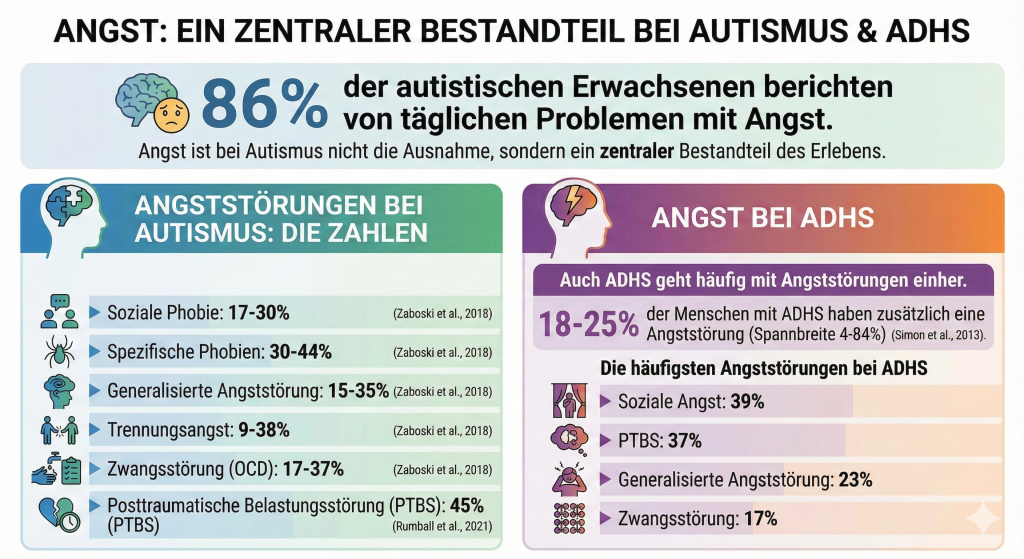
Anxiety disorders in autism: the figures
Research by Zaboski et al. (2018) documents the various anxiety disorders in autistic people:
- Social phobia: 17-30%
- Specific phobias: 30-44%
- Generalised anxiety disorder: 15-35%
- Separation anxiety: 9-38%
- Obsessive-compulsive disorder (OCD): 17-37%
- Post-traumatic stress disorder (PTSD): 45% (Rumball et al., 2021)
Anxiety in ADHD
ADHD, too, is frequently accompanied by anxiety disorders. Simon et al. (2013) report that 18-25% of people with ADHD also have an anxiety disorder (ranging from 4–84% depending on the study).
The most common anxiety disorders in ADHD:
- Social anxiety: 39%
- PTSD: 37%
- Generalised anxiety disorder: 23%
- Obsessive-compulsive disorder: 17%
What triggers anxiety?
Attwood and Garnett identify specific triggers and situations for anxiety:
- Unexpected changes: For example, when furniture in the bedroom is rearranged
- Crowded places: Shopping centres or busy streets
- Unwanted social attention: The need to be alone
- Being teased: With many negative thoughts and emotions
- Overload: Overstimulation from long social events
- Uncertainty: Unknown upcoming events or changes
- Transitions: Switching between activities or environments
- Perfectionism: Worry about making mistakes – a phobia of being wrong
- Loss of control: Situations in which one cannot cope with the unexpected
- Sensory experiences: Certain sensory impressions can trigger phobic reactions
- Changes of plan: When a fixed plan is changed
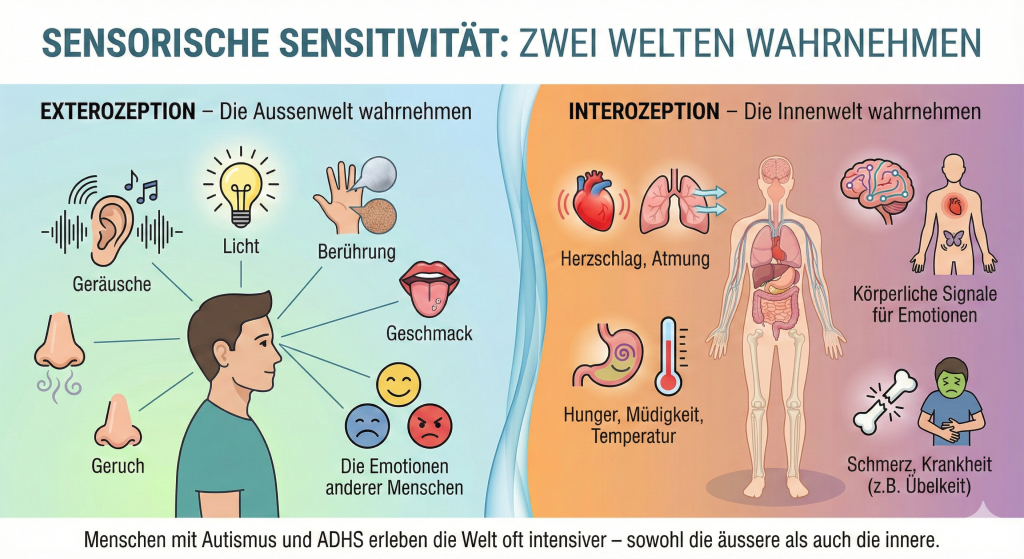
Sensory sensitivity: perceiving two worlds
People with autism and ADHD often experience the world more intensely – both the outer and the inner world:
Exteroception – perceiving the outer world:
- Sounds, light, touch, smell, taste
- Other people’s emotions
Interoception – perceiving the inner world:
- Pain, illness (e.g. nausea)
- Heartbeat, breathing
- Hunger, tiredness, temperature
- Bodily signals of emotions
The psychological consequences
Untreated anxiety and sensory overload can lead to further problems:
In childhood:
- Oppositional defiant behaviour or conduct disorders
- Anxiety disorders
- Sleep disorders
In adolescence and adulthood:
- Addiction
- Depression
- Eating disorders
Find out more at the Biomarker Workshop 2025
On 11 December 2025, Dr Corinne Henzen will present her talk “From case vignette to neurobiology: the cingulate system and hypersensitivity as transdiagnostic markers in autism, anxiety disorders and ADHD”.
Registration: https://gtsg.ch/en/biomarker-workshop-2025/
Source: handout “Understanding Autism and ADHD” by Prof. Tony Attwood & Dr Michelle Garnett, 2025