Nov 1, 2026 · @Andreas Müller
A Stone Age brain in the digital age: what ADHD, autism, trauma and sensitivity have to do with our origins
An insight into Bettina Henkel’s treatment concept – a foretaste of the Biomarker Workshop 2026 on 10 December in Zurich
“Is ADHD an illness?” Bettina Henkel, neurologist and psychiatrist/psychotherapist, regularly puts this question to her patients. Most of them hesitate. Her own answer is surprising: not per se. She understands ADHD and autistic traits as spectrum talents – genetically determined, like eye or hair colour. Something only needs treatment once it causes suffering.
In an in-depth conversation with the GTSG, she explained how she helps people understand themselves better. She stresses that much of it is deliberately simplified. It is a thinking model that gives patients orientation – not a finished theory.
Learning from diabetes
To explain how mental suffering develops, Henkel uses an image everyone knows: type 2 diabetes. It takes a genetic predisposition and a burden from outside. Someone with the predisposition who lives on cream cake all their life is more likely to fall ill than someone who eats wholemeal bread. Some stay healthy despite the cream cake; others fall ill after just a few slices.
The regulatory circuits in the brain work in exactly the same way, says Henkel. Those with little leeway can be thrown off balance by small things. In research, this principle is known as the vulnerability-stress model. And as with diabetes, the same applies to treatment: first identify and reduce the burdens, then – if necessary – add aids such as medication.
Two ways of thinking
Henkel’s description of two thinking styles is particularly striking. The ADHD-type brain thinks in analogies: “I’ve seen this before, so it will turn out like that.” This is fast and saves energy, but it is prone to error. The autistic-type brain processes every situation thoroughly from scratch. This costs time and energy, but it is more accurate.
From this perspective, much becomes understandable. Someone who has to interpret every glance anew would rather look away – not out of disinterest, but because the processing costs too much energy. And someone who has to examine every new situation thoroughly experiences change as exhausting. Research on “predictive processing” in autism describes something similar: deviations from what is expected are weighted particularly heavily.
Made for the Stone Age
Our genes, says Henkel, are optimised for the life Homo sapiens led for by far the greatest part of its history: as hunter-gatherers. On the move during the day, at rest at night, in a group that needed many different talents. The spectrum of what counted as “normal” was broader.
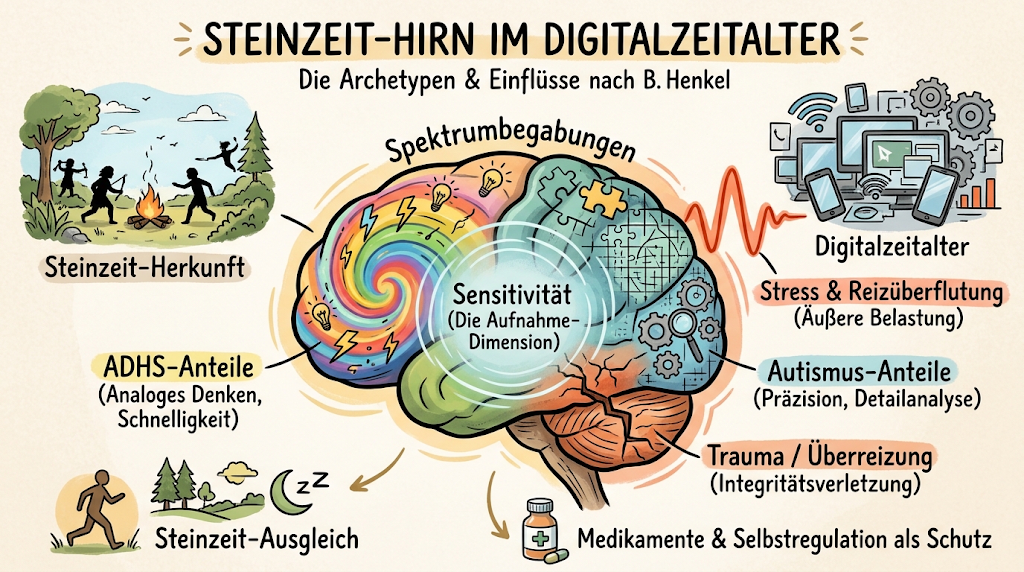
Then the world changed in waves. Agriculture above all challenged the immune system and nutrition. Industrialisation demanded sitting still and sustained attention – it is no coincidence that “Fidgety Philip” from Struwwelpeter is a child from a well-to-do family at the dinner table, not a farmer’s child out in the fields. And the digital revolution brings a density of stimuli for which our nervous system is not prepared. The more narrowly society defines the spectrum, the more people at its edges are labelled as ill. This “mismatch” idea is also discussed in science, but it remains controversial.
Sensitivity: the underestimated dimension
Alongside ADHD and autistic traits, Henkel brings a third dimension into play: sensitivity. It determines how much we take in from our environment and what it does to us. It is partly innate, but unlike the other two traits it can, in Henkel’s experience, be changed. Stressful experiences and trauma increase it; good experiences can lower it again.
Research knows related concepts, such as “sensory processing sensitivity” or the observation that more sensitive people react more strongly to bad – but also to good – environments. For Henkel, this is the most important starting point for therapy.
Trauma: when stimuli violate integrity
Henkel deliberately takes a broad view of trauma: any stimulus that disturbs a person’s integrity is traumatising. This is not meant in an inflationary sense, but an individual one. Those who are more sensitive by nature experience more stimuli as unpleasant and are therefore more easily hurt. Besides distressing experiences, she also includes physical events: after infections such as Covid, or in chronic fatigue syndrome (CFS), she observes sensitivity rising sharply.
Both thinking styles make people vulnerable in their own way. The ADHD-type brain sometimes draws its analogy too quickly – if that goes wrong, it can be traumatising. The autistic-type brain needs a long time to grasp a situation and is unprotected during that phase. Henkel tells of a mother who never lets her autistic son out of her sight in the supermarket: he probably would not scream in time if someone took him – because he first has to understand what is happening.
In the model, trauma is therefore doubly important: as a secondary condition for which ADHD and autistic traits are a risk factor, and as a force that permanently ramps up sensitivity. This is exactly where treatment comes in. The basic disposition cannot be changed, but sensitivity can. That is why, in her initial case history of around two hours, Henkel carefully separates what someone brings with them from the “damage on top” that has been added.
What this can look like in the brain is shown by studies on post-traumatic stress disorder: many of those affected have strikingly little alpha activity in the resting EEG – a sign of persistent hyperarousal. The obvious advice, “Just relax”, often does little to help them.
Stress: the alarm on permanent duty
In Henkel’s model, stress is the “burden from outside” – the second element of the diabetes formula. How much of it someone can tolerate depends on their disposition. For someone living close to the limit of wellbeing, a sideways glance is sometimes enough. Others endure catastrophes without falling ill.
She explains why modern stress costs so much energy with our Stone Age heritage: our nervous system first evaluates every stimulus on the principle of “dangerous or not”. Only then does it habituate. In a world with few stimuli, that made sense. Today, with noise, screens and constant availability, it turns into a permanent state of operation – for Henkel, a “huge waste of energy”.
This is particularly treacherous for people with low baseline arousal. They seek stimulation, often without end, but do not sense in time when it becomes too much. Our brain never needed such a warning point, says Henkel – there simply weren’t that many stimuli. Chronic stress acts like trauma: it drives sensitivity up, and heightened sensitivity makes every further stimulus more exhausting. Stress and sensitivity thus reinforce each other.
For Henkel, the consequence is not to put the blame on society. “We ourselves are society,” she says. It is about recognising one’s own burdens and regulating them consciously – with mindfulness for what does one good and what does not.
Re-enacting the Stone Age
What does this mean for everyday life? Henkel’s recommendation sounds simple: re-enact a little bit of the Stone Age every day. Vigorous exercise during the day, genuine rest without stimuli at night. Our sensory system cannot be switched off – it only comes to rest when there is nothing to process.
For people with high tension, for instance after trauma, the following applies: sometimes the better way is to activate them first – through sport, for example – and then let go. Neurofeedback studies in post-traumatic stress disorder show a related phenomenon: after targeted suppression of the alpha rhythm, it can subsequently return, accompanied by less tension.
Medication as prophylaxis
And medication? Henkel compares it to a cholesterol-lowering drug. High cholesterol was a survival advantage in the Stone Age; today it is a risk factor. Nobody waits for the heart attack before acting. She sees ADHD or autistic traits in a similar way: not an illness, but a risk for secondary conditions such as depression, trauma-related disorders or addiction. Medication can help prevent these – as a complement to self-regulation, never as a substitute. And always with an open eye on side effects: “I cannot promise you anything without side effects.” The decision lies with the patients.
More at the workshop
Sensitivity and stress as connecting dimensions across ADHD, autism and PTSD – this is exactly the focus of the Biomarker Workshop 2026 – ADHD · Autism · PTSD · Sensitivity on Thursday, 10 December 2026, at the Paulus Akademie in Zurich. Bettina Henkel will be speaking. Together with her, we ask: How can one recognise one’s own basic disposition? What role does sensitivity play in diagnosis and therapy? And how do we get a Stone Age brain safely through the digital age? The workshop is aimed at professionals; participation on site or online via Zoom.