
Almost every session begins with the same question: “So, how have you been since last time?”
It is a good question. It is also the only one most treatments have for finding out whether they work. And it has a design flaw worth knowing about: it asks a person to summarise two, four or six weeks of their life — in exactly the state they happen to be in today.
Someone having a bad day remembers the past weeks as darker than they were. Someone having a good day underestimates how hard that Wednesday three weeks ago was. On top of that, we are poor at remembering trajectories. What sticks are the peaks and the end — the worst moment and the last few days. The calm, slowly rising middle section, which is precisely what matters in therapy, leaves hardly any trace.
This is not a weakness of individual patients. It is the normal way memory works. It is simply ill-suited as a measuring instrument.
What happens when you measure instead
The question of whether it helps to record progress regularly rather than ask about it has been well studied. In psychotherapy research it goes by the name of routine outcome monitoring: patients are given a brief, standardised instrument at short intervals, and the result is fed back to the clinicians.
The most comprehensive synthesis to date comes from Lambert, Whipple and Kleinstäuber (Psychotherapy, 2018). For one of the widely used systems, it pools 15 studies with 8,649 patients. Two of its results are remarkable.
The first is sobering. Averaged across all patients, the effect is small (effect size 0.14). Anyone who expects measurement in itself to make therapy better will be disappointed. When treatment is going well anyway, feedback changes little.
The second is the real point. For those patients whose progress was unfavourable — in technical terms not on track — the effect was considerably larger (0.33), and when the feedback was combined with concrete pointers for how to proceed, it reached a medium magnitude (0.49). Under feedback, this group was almost twice as likely to improve and less likely to deteriorate.
The benefit, then, does not lie in confirming success. It lies in noticing failure early enough.
And this is precisely what clinicians demonstrably find difficult. The same work states plainly that clinicians often fail to recognise deterioration and are poor at estimating how much a treatment will achieve in the end. This is no reproach to their diligence. It is the predictable consequence of seeing a person for fifty minutes every two weeks and having to reconstruct the rest from their account.
What tracking actually achieves
From this body of evidence, four things follow that regular recording can do and that conversation alone cannot.
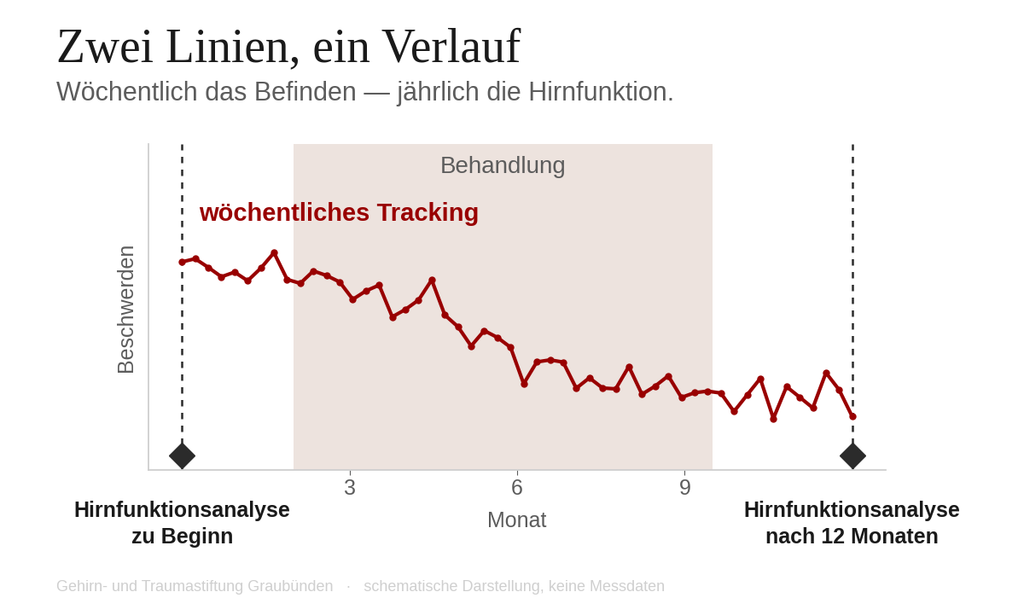
It makes the direction visible. Individual values fluctuate; a line over twelve weeks shows a trend. Only the trend answers the question that matters.
It separates a bad day from a bad course. Measuring weekly shows whether a dip was an outlier or the start of a downward movement. In a conversation on a given day, the two cannot be told apart.
It sets a point in time for changing course. The benefit of measuring arises where a decision follows from the finding: adjusting the dose, switching the method, checking accompanying factors. A course that nobody looks at is documentation, not steering.
It gives those affected something to hold on to. Those who make their own entries over weeks see their own curve — and with it the improvement that gets lost in everyday life, because people get used to their new state faster than they think.
The HBImed Therapy Tracking App is built for exactly this purpose: short, regular entries by those affected, resulting in a course that the treating professional has in summarised form before the next session. The analysis is connected to the rest of the system, so that the course appears together with questionnaire results, test performance and brain function findings rather than separately.
And brain function?
It seems natural not to base progress monitoring on self-report alone. What can be measured can be repeated: a brain function analysis is quick to record (75 min) and requires nothing of the person examined that they would have to report. A progress assessment that places clinical impression, structured self-report and a physiological measurement side by side would be more robust than any of the three alone – because each of the three can be wrong in a different place.
This is the direction we are working in. It is not yet the state of the art. On the question of whether treatment-related changes are reliably reflected in electrophysiological metrics – and from what magnitude a change is more than the normal fluctuation between two measurements – the data are thin. Anyone who presents an EEG course today as proof of efficacy goes beyond what has been demonstrated.
How we handle it in practice
In our practice, we usually repeat the brain function analysis every twelve months. The interval is chosen deliberately: long enough for a treatment to have had time to work, and short enough for a change still to be attributable to a particular phase of treatment. This creates a second, repeatable line alongside the clinical impression – one that does not depend on how someone describes their condition on the day of the examination.
This measurement only reveals its value in combination with tracking. The weekly entries show how a year has gone – with its dips, plateaus and progress. The brain function analysis shows whether something has also shifted at the level of brain function during that year. Where both point in the same direction, the assessment becomes more robust. Where they diverge, this is not a contradiction but a question that could not even have been asked without the second measurement.
Where measurement reaches its limits
Three limitations belong here, otherwise a useful tool turns into a promise.
What is measured is what the instrument asks about. A questionnaire reflects what it was built for. What it does not contain — a side effect, a changed relationship, a new conflict — does not show up in the curve, no matter how regularly one measures.
Numbers can crowd out the conversation. The benefit arises when the course structures the conversation. It reverses when the curve replaces the conversation.
Regular completion is a burden. Weekly entries cost those affected attention, and precisely when they are feeling unwell. An instrument that is too long for this will not be completed — and a course with gaps is more misleading than none at all, because it is precisely the bad weeks that are missing.
And the matter that is taken for granted but should not be: what people record about how they feel is among the most sensitive data there is. Anyone who collects such courses owes an account of where they are stored, who sees them and what happens to free-text entries.
The honest summary is unspectacular. Regular measurement does not make bad therapy good. It ensures that a therapy that is not working is recognised as such earlier — and measured against what a lost phase of treatment costs, that is no small gain. Especially not for the patients themselves.
Source:
- Lambert, M. J.; Whipple, J. L.; Kleinstäuber, M. Collecting and delivering progress feedback: A meta-analysis of routine outcome monitoring. Psychotherapy, 2018, 55(4), 520–537.