Part 5 of the article series on the Biomarker Workshop 2025
The treatment of people with autism and/or ADHD has changed fundamentally in recent years. Away from fighting symptoms, towards a holistic approach that understands neurodiversity as a natural variation of human neurology.
The new paradigm: acceptance instead of normalisation
Attwood and Garnett describe a fundamental shift in therapy:
- No longer: “Repairing” the core symptoms of autism and ADHD with psychological, speech or occupational therapy
- Instead: Embracing neurodiversity (self-acceptance) for greater mental well-being and quality of life
This is achieved by:
- Increasing self-awareness and self-acceptance
- Treating co-occurring mental health conditions
- Caring for the physical body
- Providing support and accommodations
Medication in AuDHD: caution required
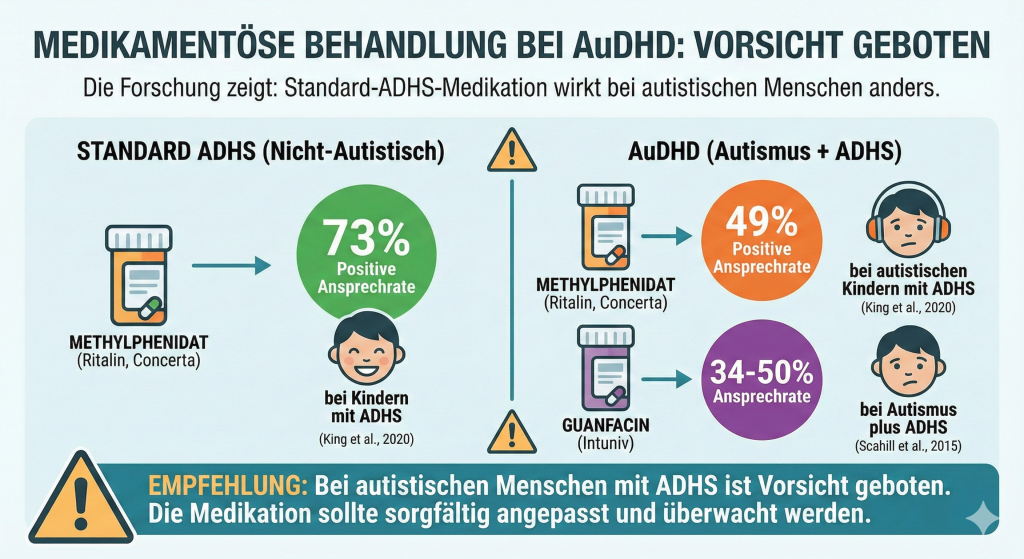
Research shows that standard ADHD medication works differently in autistic people:
- Methylphenidate (Ritalin, Concerta): 73% positive response rate in children with ADHD, but only 49% in autistic children with ADHD (King et al., 2020)
- Guanfacine (Intuniv): 34–50% response rate in autism plus ADHD (Scahill et al., 2015)
The recommendation: in autistic people with ADHD, caution is required. Medication should be carefully adjusted and monitored.
Physical exercise and mindfulness
Physical exercise has a proven positive effect on executive functions. A study by Tse et al. (2025) in the journal “Autism” shows that cycling (mobile and stationary) leads to significant improvements.
Mindfulness demonstrably changes the brain. A meta-analysis of 123 studies (Fox et al., 2015) identified 8 brain regions that are consistently altered by daily mindfulness practice – all relevant to ADHD and/or autism.
Recommended approaches:
- Mind-body practices: yoga, meditation, tai chi, taekwondo
- Acceptance and Commitment Therapy (ACT)
- Compassion Focused Therapy (CFT)
- Dialectical Behaviour Therapy (DBT)
- Internal Family Systems (IFS)
Diagnosis as a turning point
Attwood and Garnett emphasise that the diagnosis is a decisive event for identity formation. They prefer the term “discovery” to “diagnosis” because it emphasises the positive aspect: finally understanding why one is different.
Research by Cooper, Smith and Russell (2017) shows that, although autistic people report mental health problems more often, a positive autistic social identity offers a protective factor.
What helps:
- Fostering positive autistic identities
- Positive online community support that focuses on strengths
- Self-help groups that enable personal exchange and emphasise strengths
Recognising and using strengths
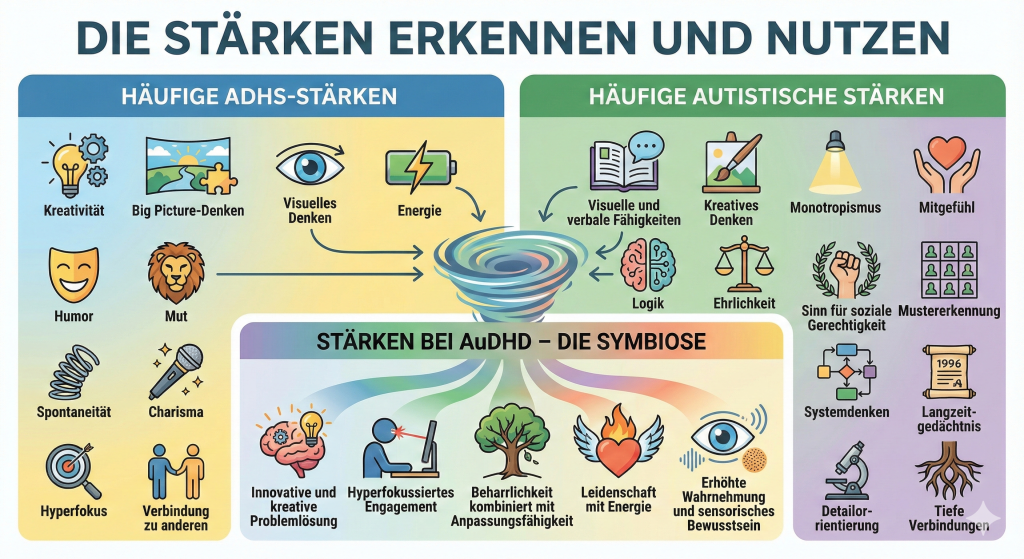
Common ADHD strengths:
Visual thinking, “big picture” thinking, creativity, energy, humour, courage, spontaneity, charisma, hyperfocus, connection with others
Common autistic strengths:
Visual and verbal abilities, creative thinking, monotropism, compassion, logic, honesty, a sense of social justice, pattern recognition, systems thinking, long-term memory, attention to detail, deep connections
Strengths in AuDHD – the symbiosis:
- Innovative and creative problem-solving
- Hyperfocused engagement
- Persistence combined with adaptability
- Passion with energy
- Heightened perception and sensory awareness
Understanding and explaining neurodiversity
Attwood and Garnett recommend explaining autism and ADHD as follows:
- A different way of feeling, thinking, learning and relating
- Based on a different neurology
- There are many different ways of being autistic or having ADHD
- With advantages and disadvantages
- Being misunderstood is often a disadvantage
- Knowing one’s own neuroprofile helps
Find out more at the Biomarker Workshop 2025
On 11 December 2025, Matthias Huber will give his talk “Understanding therapy from within: how a therapist’s own lived experience decisively shapes autism treatment”.
Source: handout “Understanding Autism and ADHD” by Prof. Tony Attwood & Dr Michelle Garnett, 2025
This is part 5 and the conclusion of the article series based on the handout by Prof. Tony Attwood and Dr Michelle Garnett for the Biomarker Workshop 2025.