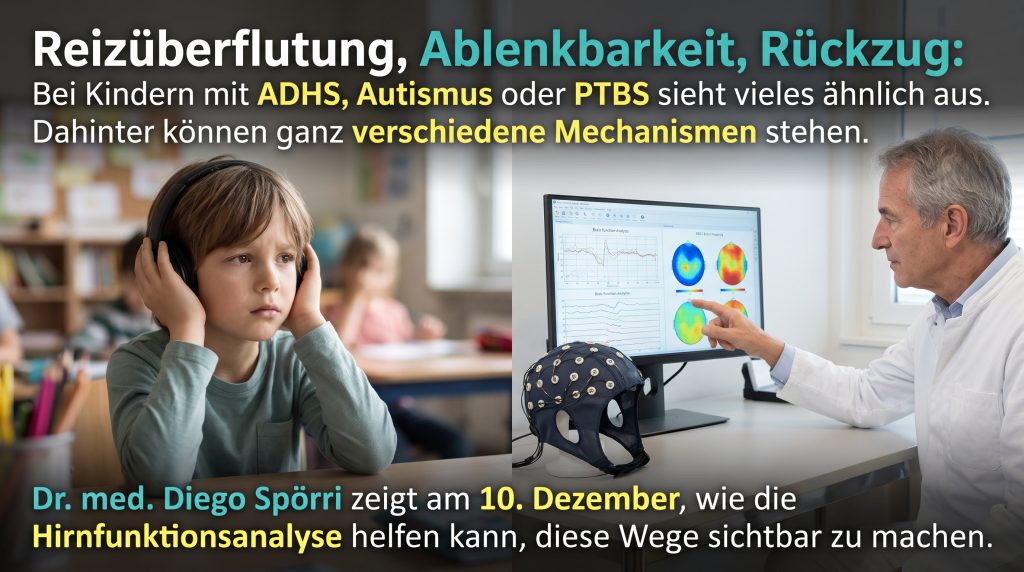
Sensory overload, distractibility, withdrawal: in children with ADHD, autism or PTSD, much looks alike. Yet quite different mechanisms may lie behind it. On 10 December, Dr. med. Diego Spörri will show how brain function analysis can help make these pathways visible.

In the waiting room the phone rings, a baby cries next door, the door opens and closes. For some children this is hardly worth mentioning. Others cover their ears, become fidgety, withdraw or are completely exhausted after the appointment.
Dr. Diego Spörri is a paediatrician with his own practice in Paudex
Paediatricians are often the first to see such reactions. In children with ADHD, autism or post-traumatic stress disorder (PTSD), they can look very similar: sensory overload, distractibility, avoidance, intense emotional reactions and fatigue.
Similar picture, different mechanisms
Diego Spörri pursues a question that is decisive for treatment: what lies behind the same behaviour? He describes three possible pathways.
- ADHD: Selecting what to attend to and exercising executive control are harder. Competing stimuli are less easily filtered and managed.
- Autism: Stimuli are modulated differently, and habituation to recurring stimuli is reduced. This can lead to sensory overload.
- PTSD: Stimuli associated with threat trigger heightened vigilance and defence.
These pathways are not mutually exclusive. A child may show several of them. And stress can amplify each one, because it limits the capacity for flexible self-regulation.
What brain function analysis can contribute
From the outside, it is often impossible to tell which mechanism predominates. This is where brain function analysis (BFA) comes in. It describes the brain’s electrical activity, for example through the distribution of frequencies (spectral power) and the interplay between brain regions (connectivity).
In addition, there are event-related potentials (ERPs). They show how the brain responds to a specific stimulus. This is complemented by attention tasks on screen, for example a Go/No-Go task: the child responds to certain pictures and holds back on others.
Together, these approaches provide a framework for making the processes behind sensory processing, attention and control visible. They replace neither the case history nor the conversation with the child and parents. They add an objective perspective to the clinical view.
The link to the workshop
The 2026 workshop asks whether ADHD, autism and PTSD share underlying dimensions: sensitivity and stress. Spörri’s approach translates this question into everyday clinical practice. What matters is not only the diagnosis, but also the pathway through which stimuli burden a child and how stress amplifies this.
Those who understand this can intervene more precisely in everyday life, at school and in therapy.
The talk
Dr. med. Diego Spörri, paediatrician in the Lausanne region, will speak on Thursday, 10 December 2026, at 1.45 pm on “ADHD, autism and trauma in paediatric practice”.
Biomarker Workshop 2026: Thursday, 10.12.2026, 9.00 am–5.00 pm, Paulus Akademie Zurich and online. CHF 100, 7 credits.Programme here; Register now