
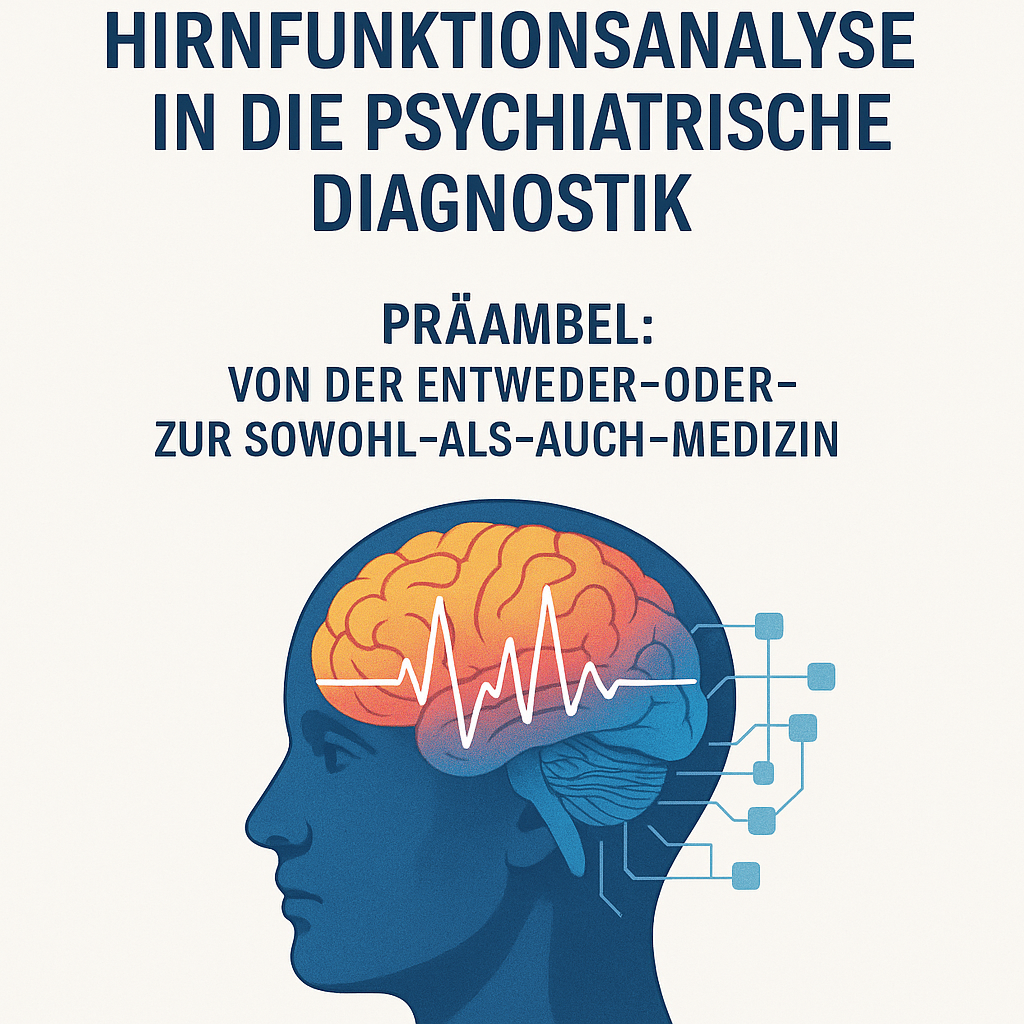
Preamble: from either-or medicine to both-and medicine
Modern psychiatry is at a turning point. With more than 970 million people worldwide affected by mental disorders, and diagnostic agreement rates for major depression reaching kappa values of just 0.28–0.32, it is time to expand our diagnostic tools. Brain function analysis (BFA) is not a competitor to clinical expertise but its scientific complement – for the benefit of our patients.
Thesis 1: technology enables a deeper human relationship
The accusation: BFA is technical and cold, whereas traditional psychiatry and psychology meet people where they need it – at the level of the relationship.
The reality: It is precisely the objective certainty that BFA offers that creates the basis for a more robust therapeutic relationship. When a mother brings her child for assessment and, after a detailed conversation, there is still uncertainty as to whether ADHD, autism, anxiety or a combination is present, this burdens the relationship. The average delay of 9.5 years until a correct diagnosis of bipolar disorder means almost a decade of uncertainty, ineffective treatment attempts and dwindling trust.
BFA works like an X-ray: nobody would claim that an X-ray prevents the doctor’s relationship with a patient who has bone pain. On the contrary – it creates clarity and enables targeted help. The same applies to BFA: it objectifies what is happening in the brain and thereby enables more precise interventions and more honest conversations.
The scientific evidence: Studies show that patients who receive a clear, biologically grounded diagnosis show higher treatment adherence and a better response to therapy. Integrating objective biomarkers increases confidence in diagnostic decisions – among clinicians and those affected alike. If we are honest: what gives a mother more certainty and trust – yet another subjective opinion, or objective confirmation through neurobiological data that validate her perception?
Thesis 2: clinical application does not require complete clarification of causality
The accusation: The causes of psychiatric disorders have not yet been fully clarified, so BFA must not be used.
The reality: This line of argument would paralyse the whole of medicine. We do not fully know the exact causes of migraine, Crohn’s disease or multiple sclerosis – yet we treat these conditions successfully every day. Medicine has always worked with pattern recognition and empirical evidence, long before all causal mechanisms were understood.
BFA reliably identifies patterns of neural activity associated with specific conditions. In 2022, the High-Dimensional EEG Connectivity Study Group achieved a classification accuracy of 98.85 per cent for ADHD using 4D/6D connectivity tensors. These patterns are reproducible, validated and clinically relevant – regardless of whether we fully understand every single neurotransmitter receptor and every genetic variant.
The principle: We do not need to know the ultimate cause in order to use reliable diagnostic markers. What matters is empirical validation: does BFA consistently and reproducibly show differences between patient groups and healthy controls? The answer from current research is clear: yes. Meta-analyses across thousands of patients confirm this. The question is not whether the method is scientifically grounded, but when we will finally integrate it systematically into clinical practice.
Thesis 3: the diagnosis remains clinical – BFA broadens the perspective
The accusation: Diagnoses must always be clinical; a technical examination cannot replace this.
The reality: There is a fundamental misunderstanding here. Nobody is demanding that BFA replace clinical diagnostics. The vision is an integrative, multimodal diagnostics that combines the best of different worlds:
- The detailed clinical interview captures the person’s subjective experience, life history, family stresses and individual resources.
- The thorough case history traces the development of symptoms over time and identifies biographical triggers and patterns.
- Structured questionnaires standardise symptom assessment and enable comparisons over time and between different raters.
- Neuropsychological diagnostics objectifies cognitive strengths and weaknesses in attention, memory, executive functions and socio-emotional processing.
- Brain function analysis completes this picture by directly measuring neural activity and connectivity – it shows what happens in the brain while the person thinks, feels and acts.
Together, these five pillars form a comprehensive diagnostic foundation. BFA does not replace clinical assessment – it extends it with an objective, neurobiological dimension. The final diagnosis naturally remains an overall clinical assessment that integrates all available information.
The paradigm shift: from categories to dimensions
Integrating BFA enables the long-overdue paradigm shift from rigid diagnostic categories to flexible, dimensional models. Research shows that 50–70% of people with autism also meet the criteria for ADHD, while the genetic overlap is 50–72%. These high comorbidity rates are not a diagnostic failure – they reflect biological reality.
BFA allows us to capture these overlaps precisely and to create individual neurobiological profiles. Two patients with the same DSM-5 diagnosis can show completely different patterns of brain function – and respond correspondingly differently to treatment. BFA makes these differences visible and enables personalised treatment planning.
The economic and ethical obligation
The health-economic evidence is overwhelming: EEG-based biomarker systems pay for themselves within a year. Per 1,000 patients, an investment of CHF 296,518 over five years means savings of CHF 1.5 million – a net gain of CHF 1.2 million. After the first year, each diagnosed patient continuously generates savings of CHF 1,500 per year through more precise treatment and avoided hospitalisations.
But it is about more than money. It is about human lives. It is about the autistic girl who is only diagnosed at 13 instead of 8 – five lost years in which support could have taken effect. It is about the young man with bipolar disorder who waits 9.5 years for the correct diagnosis and during this time receives ineffective antidepressants that worsen his mania. It is about the mother with depression who loses trust in treatment after the fourth unsuccessful medication trial.
We have the scientific tools to shorten these diagnostic odysseys. We have the economic arguments for implementing them. The question is: do we have the ethical will to use them?
Practical integration: evolution rather than revolution
Successfully integrating BFA does not require a radical break with proven clinical practice, but its systematic extension:
Phase 1 – indication: After the detailed initial clinical interview and case history, the professional decides whether additional objective data would increase diagnostic certainty. BFA is particularly valuable in complex cases, unclear comorbidities or atypical presentations.
Phase 2 – recording: BFA is carried out by trained staff while the professional continues with the rest of the diagnostic work-up. No unnecessary waiting times arise.
Phase 3 – integration: The BFA findings are integrated into an overall assessment together with all other diagnostic information. Contradictions between the clinical impression and the BFA findings are addressed and can lead to more in-depth exploration.
Phase 4 – monitoring: BFA enables objective monitoring of the course of treatment and early identification of relapses or side effects.
Closing words: the time is ripe
The scientific evidence is clear. The economic justification is overwhelming. The ethical obligation towards our patients is clear. Brain function analysis is not a competitor to clinical psychiatry and psychology – it is their natural further development in the 21st century.
We face a choice: do we stay with diagnostic agreement rates of 28–32% and thereby prolong our patients’ suffering? Or do we integrate the available scientific tools into modern, multimodal diagnostics that does justice to people in their biological and psychological complexity?
The vision of a neurodiversity medicine that grasps people in their uniqueness and supports them optimally – not through normalisation, but through tailored interventions – is no longer a distant utopia. Today it is scientifically possible, economically sensible and ethically imperative.
The time for objective psychiatric diagnostics is now.
Brain and Trauma Foundation Grison
Biomarker Workshop 2025 | 11 December 2025 | Zurich