Part 3 of the article series on the Biomarker Workshop 2025
“I can dance. I can dance with anyone who wants to dance with me, but it is always their choreography.”
This quote aptly describes what many autistic people – especially women – experience every day: they have learned to adapt, to follow social rules and to appear “normal”. But it is always a performance, never authentic.
What is camouflaging?
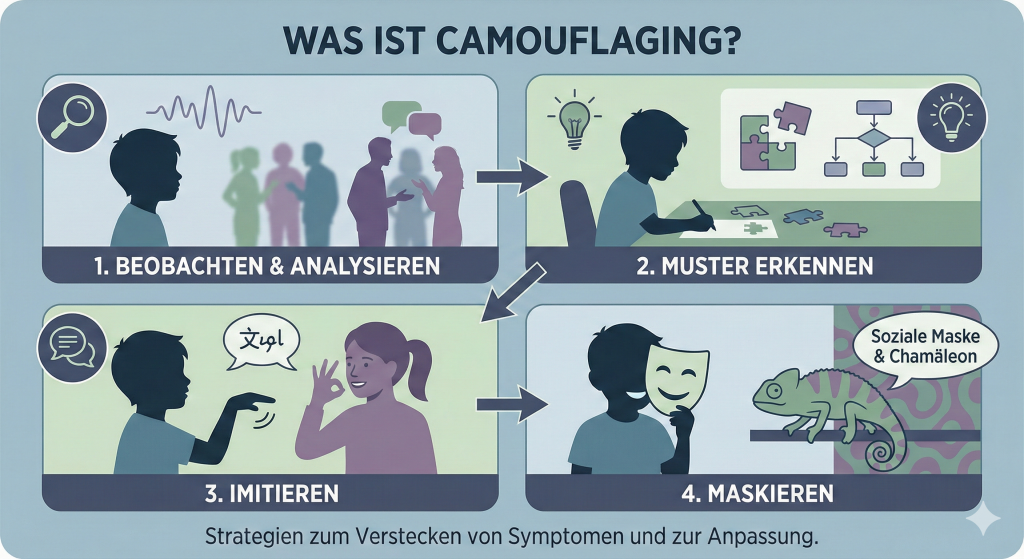
Camouflaging refers to the conscious or unconscious strategies neurodivergent people use to hide their symptoms in order to fit in. Attwood and Garnett describe the process as follows:
- Observing and analysing: Autistic children closely observe social interactions
- Recognising patterns: They try to learn social patterns and systems
- Imitating: Social skills are acquired through intellectual analysis rather than intuition
- Masking: They create a social mask and become “chameleons”
The early start
Camouflaging often begins in early childhood. Autistic children are very aware of their difficulties:
- They know that they struggle to read non-verbal communication
- They do not intuitively understand how to make and maintain friendships
- They are initially distant from their peers
- They observe social interactions attentively
- They seek to belong to a group in order to avoid bullying
The psychological costs
Constant masking comes at a high price:
- Loss of the authentic self: “I don’t know who I really am”
- Low self-esteem: Linked to persistent self-analysis
- Fear of exposure: The worry that friendships are based on deception and a false identity
- Deep inner loneliness: Intensified by the gap between the mask and the true self
- Fear of rejection: “If my true self is revealed, I may be rejected and despised”
“I try to be the person they want me to be.”
“I have done such a good job of appearing normal that nobody really believes I am autistic.”
Gender differences in camouflaging
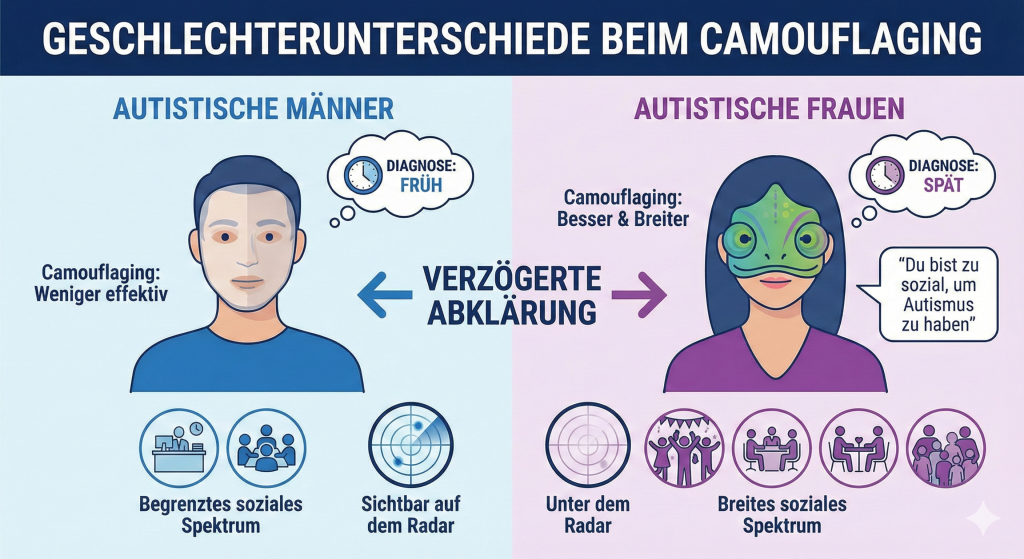
Research shows clear differences between the sexes:
- Autistic women tend to be better at camouflaging than autistic men
- They use this adaptive strategy in a wider range of social situations
- They “fly under the autism radar” and delay a diagnostic assessment
- They often hear: “You are too social to be autistic”
Camouflaging in AuDHD
People with AuDHD (autism + ADHD) experience a double burden of masking:
- Camouflaging in order to fit in, avoid bullying and be accepted
- Suppressing both autistic and ADHD symptoms
- Exhausting
- The feeling that others do not accept the autistic self
- Unrealistic expectations from others
- Grief over the loss of the “true self”
Why objective diagnostics helps
Especially in people who camouflage successfully, purely behaviour-based diagnostics can fail. This is where objective biomarkers can make a decisive contribution: they capture neurobiological patterns that become visible independently of social performance.
Find out more at the Biomarker Workshop 2025
On 11 December 2025, international experts in Zurich will discuss how integrative diagnostics works in ADHD, autism and anxiety disorders.
Source: handout “Understanding Autism and ADHD” by Prof. Tony Attwood & Dr Michelle Garnett, 2025