Abstract
Attention deficit/hyperactivity disorder (ADHD), autism spectrum disorders (ASD), anxiety disorders, and sleep disorders show high rates of comorbidity with complex bidirectional relationships. This systematic review analyzes current research findings on prevalence, neurobiological mechanisms, and evidence-based treatment approaches. Over 80% of people with ASD suffer from sleep problems, while 28% also have ADHD. Anxiety disorders occur in 27-43% of people with ASD. Disturbed melatonin secretion and circadian rhythm disorders are central pathophysiological mechanisms. Meta-analyses show significant efficacy of melatonin therapy and cognitive behavioral therapy (CBT). Multimodal treatment approaches combining pharmacological and behavioral interventions are proving to be the most promising for these complex, interrelated disorders.
Keywords: ADHD, autism spectrum disorder, sleep disorders, anxiety disorders, melatonin, cognitive behavioral therapy
Introduction
In recent years, research into neurodevelopmental disorders has yielded significant insights into the complex relationships between attention deficit/hyperactivity disorder (ADHD), autism spectrum disorders (ASD), anxiety disorders, and sleep disorders. These disorders often occur comorbidly and share common neurobiological mechanisms, posing both diagnostic and therapeutic challenges.
Prevalence and epidemiological correlations
Comorbidity rates for autism spectrum disorders
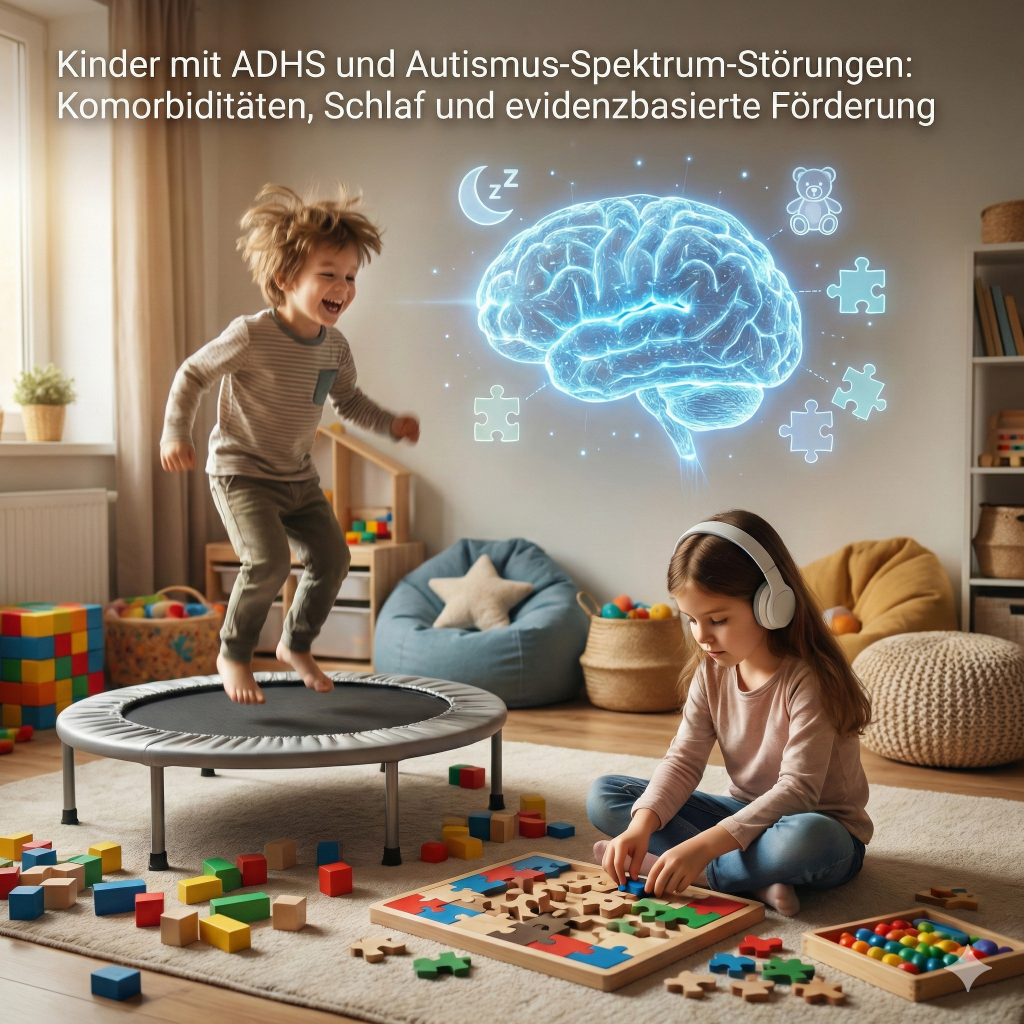
Current epidemiological studies demonstrate impressive statistical correlations between the disorders mentioned. Over 80% of people with ASD have sleep problems, while 20-70% also meet ADHD criteria (with large study variance due to methodological differences). Conversely, 20-50% of people with ADHD also have an autism spectrum disorder. Anxiety disorders occur in 27-43% of people with ASD, compared to significantly lower rates in the general population.
Neurobiological mechanisms and etiology
Melatonin dysfunction as a central mechanism
A key factor in the pathophysiology is impaired melatonin secretion. People with ASD and ADHD consistently show abnormal melatonin levels, with low melatonin concentrations in urine, serum, or plasma documented in both disorders (Mazurek & Petroski, 2015; Van der Heijden et al., 2005).
Genetic studies have identified rare variants in melatonin-related genes (AANAT, ASMT, MTNR1A, MTNR1B) in people with ASD that affect melatonin synthesis and corresponding receptors (Melke et al., 2008; Chaste et al., 2011).
Circadian rhythm disorders
Studies have demonstrated delayed DLMO (dim light melatonin onset) and increased excretion of 6-hydroxymelatonin sulfate in ADHD. Children with ADHD and sleep disorders typically present with delayed DLMO and shifted sleep phases (Van der Heijden et al., 2005).
Anxiety disorders exacerbate this problem through psychological hyperarousal, which leads to difficulty falling asleep. The combination of ASD with anxiety or ADHD can lead to particularly severe and treatment-resistant insomnia (Keefer & Vasa, 2021).
Pharmacological treatment approaches
Melatonin therapy: Evidence from randomized controlled trials
Proof of efficacy
Systematic reviews of randomized controlled trials involving children aged 2-18 years with ASD and/or ADHD demonstrated statistically significant improvements in sleep duration and sleep latency compared to placebo. The response rate in the melatonin group was consistently higher.
Meta-analyses show that melatonin has positive effects on total sleep time (SMD = 0.78), sleep latency (SMD = 1.23), and sleep efficiency (SMD = -0.70) (Arslan et al., 2022).
Dosage and response rates
Dosage recommendations are 2-10 mg before bedtime. Clinical studies show that 86% of children experience improvements in falling asleep, 54% in sleep duration, and 45% in nighttime waking cycles (Maras et al., 2018).
Safety profile
Side effects were mild and occurred in 14% of patients: fatigue, vomiting, somnolence, cough, mood swings, increased excitability, headache, and rash (Maras et al., 2018).
Prolonged-release versus immediate-release formulations
Studies demonstrate that prolonged-release melatonin is better suited for maintaining sleep, while immediate-release formulations mainly help with falling asleep (Arslan et al., 2022).
Non-pharmacological treatment approaches
Cognitive behavioral therapy (CBT)
Effectiveness in ASD and anxiety disorders
Randomized controlled trials show that adapted CBT programs are highly effective for children with ASD and anxiety disorders. Remission of anxiety disorders appears to be an achievable goal in high-functioning children with ASD (Wood et al., 2020; Storch et al., 2015).
The SENSE study of 144 adolescents (aged 12-17) with high anxiety levels and sleep disorders showed significant improvements in subjective and objective sleep parameters as well as anxiety symptoms after a cognitive behavioral therapy/mindfulness-based intervention for sleep disorders (Blake et al., 2016).
Telehealth and digital interventions
Telehealth CBT for insomnia shows promising results. Parents and children were able to successfully use telehealth CBT to improve sleep quality in children and parents, child behavior, and parental fatigue (Johnson et al., 2020).
Integrated and multimodal treatment approaches
Combination therapies
Research findings show that melatonin may also affect symptoms other than sleep alone—including anxiety, depression, pain, and gastrointestinal dysfunction—which often occur as comorbidities in ASD (Gagnon & Godbout, 2018).
Studies suggest that family cognitive behavioral therapy treatments can reduce sleep disturbances, and reducing these symptoms may also alleviate sleep problems in people with ASD (Fadini et al., 2018).
Clinical implications and practice recommendations
Diagnostic considerations
It is fundamentally important to rule out primary sleep disorders (especially sleep-related breathing disorders and periodic limb movement disorder) before diagnosing or treating ADHD (Cortese et al., 2013).
Medication for ADHD and sleep
Medication for ADHD can be complicated by complex interactions, as stimulants are often associated with sleep disturbances, while some studies also show that effective control of ADHD symptoms can promote sleep (Stein et al., 2012).
Conclusions and future research directions
Current research findings clearly show that a multimodal treatment approach combining both pharmacological (especially melatonin) and behavioral interventions is most promising for the treatment of these complex, interrelated disorders.
Future research should focus on developing personalized treatment strategies that take individual neurobiological profiles into account and further advance the optimization of combined intervention approaches.
References
Arslan, N., Bozkır, E., Koçak, T., Akin, M., & Yilmaz, B. (2022). Melatonin for sleep disorders in people with autism: Systematic review and meta-analysis. Research in Autism Spectrum Disorders, 91, 101877.
Blake, M., Waloszek, J. M., Schwartz, O., Raniti, M., Simmons, J. G., Blake, L., … & Allen, N. B. (2016). The SENSE study: Treatment mechanisms of a cognitive behavioral and mindfulness-based group sleep improvement intervention for at-risk adolescents. Journal of Consulting and Clinical Psychology, 84(12), 1039-1051.
Chaste, P., Clement, N., Botros, H. G., Guillaume, J. L., Konyukh, M., Pagan, C., … & Bourgeron, T. (2011). Genetic variations of the melatonin pathway in patients with attention-deficit and hyperactivity disorders. Journal of Pineal Research, 51(4), 394-399.
Cortese, S., Faraone, S. V., Konofal, E., & Lecendreux, M. (2009). Sleep in children with attention-deficit/hyperactivity disorder: Meta-analysis of subjective and objective studies. Journal of the American Academy of Child & Adolescent Psychiatry, 48(9), 894-908.
Cortese, S., Brown, T. E., Corkum, P., Gruber, R., O’Brien, L. M., Stein, M., … & Owens, J. (2013). Assessment and management of sleep problems in youths with attention-deficit/hyperactivity disorder. Journal of the American Academy of Child & Adolescent Psychiatry, 52(8), 784-796.
Danielson, M. L., Claussen, A. H., Bitsko, R. H., Katz, S. M., Newsome, K., Blumberg, S. J., … & Ghandour, R. (2024). ADHD prevalence among U.S. children and adolescents in 2022: Diagnosis, severity, co-occurring disorders, and treatment. Journal of Clinical Child & Adolescent Psychology, 53(3), 343-360.
Fadini, C. C., Lamônica, D. A., Fett-Conte, A. C., Osório, E., Zuculo, G. M., Giacheti, C. M., & Pinato, L. (2018). Influence of sleep disorders on the behavior of individuals with autism spectrum disorder. Frontiers in Human Neuroscience, 9, 347.
Gagnon, K., & Godbout, R. (2018). Melatonin and comorbidities in children with autism spectrum disorder. Current Developmental Disorders Reports, 5(3), 197-206.
Johnson, K. A., Turner, K. S., Foldes, E., Brooks, M. M., Kronk, R., & Wiggs, L. (2020). Telehealth cognitive behavioral therapy for insomnia in children with autism spectrum disorder: A pilot examining feasibility, satisfaction, and preliminary findings. Autism, 24(8), 2270-2284.
Keefer, A., & Vasa, R. A. (2021). DINOSAUR: An integrated cognitive-behavioral treatment for anxiety in young children with ASD. Journal of Neurodevelopmental Disorders, 13(1), 46.
Maras, A., Schroder, C. M., Malow, B. A., Findling, R. L., Breddy, J., Nir, T., … & Gringras, P. (2018). Long-term efficacy and safety of pediatric prolonged-release melatonin for insomnia in children with autism spectrum disorder. Journal of Child and Adolescent Psychopharmacology, 28(10), 699-710.
Mazurek, M. O., & Petroski, G. F. (2015). Sleep problems in children with autism spectrum disorder: Examining the contributions of sensory over-responsivity and anxiety. Sleep Medicine, 16(2), 270-279.
Melke, J., Goubran Botros, H., Chaste, P., Betancur, C., Nygren, G., Anckarsäter, H., … & Bourgeron, T. (2008). Abnormal melatonin synthesis in autism spectrum disorders. Molecular Psychiatry, 13(1), 90-98.
Solomon, S., Elbedour, L., Meiri, G., Flusser, H., Attias, J., Michaelovski, A., … & Menashe, I. (2024). Sleep disturbances are associated with greater healthcare utilization in children with autism spectrum disorder. Journal of Neurodevelopmental Disorders, 16(1), 29.
Stein, M. A. (2012). Unravelling sleep problems in treated and untreated children with ADHD. Journal of Child and Adolescent Psychopharmacology, 22(1), 90-91.
Storch, E. A., Arnold, E. B., Lewin, A. B., Nadeau, J. M., Jones, A. M., De Nadai, A. S., … & Murphy, T. K. (2015). The effect of cognitive-behavioral therapy versus treatment as usual for anxiety in children with autism spectrum disorders: A randomized, controlled trial. Journal of the American Academy of Child & Adolescent Psychiatry, 52(2), 132-142.
Van der Heijden, K. B., Smits, M. G., Van Someren, E. J., & Gunning, W. B. (2005). Idiopathic chronic sleep onset insomnia in attention-deficit/hyperactivity disorder: A circadian rhythm sleep disorder. Chronobiology International, 22(3), 559-570.
Wood, J. J., Kendall, P. C., Wood, K. S., Kerns, C. M., Seltzer, M., Small, B. J., … & Storch, E. A. (2020). Cognitive behavioral treatments for anxiety in children with autism spectrum disorder: A randomized clinical trial. JAMA Psychiatry, 77(5), 474-483.