Scientific excellence meets clinical implementation
When Prof. Dr Silvana Markovska-Simoska and Dr Aleksandar Tenev present their talk “Neurophysiological Recognition and Its Implementation in Clinical Practice” at the 14th Biomarker Workshop in Zurich on 11 December 2025, they will demonstrate more than research findings: they will show how objective biomarker diagnostics for autism is moving from theory to clinical reality. The collaboration between the neurophysiology laboratory of the Macedonian Academy of Sciences and Arts in Skopje and the Brain and Trauma Foundation Grison exemplifies the ongoing synergy between research and practice.
Convergent discoveries: parallel typologies confirm neurobiological reality
The scientific validity of neurophysiological autism subtypes is underpinned by a remarkable fact: while Michael Linden and Jay Gunkelman in the USA had been systematically studying QEEG patterns in autism since the early 2000s and identified six neurophysiological endophenotypes, Prof. Markovska-Simoska independently developed an almost identical typology in her clinical practice in Skopje.
The six autism endophenotypes comprise paroxysmal/epileptiform activity (35–70%, often associated with language development disorders), mu rhythm dysfunction (70%, central to the mirror neuron system and social cognition), high beta/beta spindles (70%, manifesting as sensory hypersensitivity, impulsivity or compulsiveness depending on location), coherence dysregulation (70%, impaired functional connectivity between brain regions), high delta activity (30%, associated with attention problems) and alpha anomalies (reduced activity compared with neurotypical children).
Over 15 years of systematic brain function analyses at the BrainARC practice in Skopje, Markovska-Simoska developed a parallel classification that integrates both frequency band analyses and modern complexity measures. This independent convergence – with different patient populations, different EEG systems and without initial knowledge of each other’s work – is of great scientific significance: it demonstrates that these subtypes are not local artefacts but reflect universal neurobiological realities.
Tenev’s algorithmic precision: machine learning objectifies clinical observations
Dr Aleksandar Tenev brought the technological precision needed to make clinical subtyping objective and reproducible. His study published in 2025 in Frontiers in Psychiatry together with Markovska-Simoska and Andreas Müller analysed 49 autistic and 39 neurotypical children using advanced entropy and complexity measures. The results were clear: neurotypical children showed increased alpha activity, while autistic children showed hardly any alpha activity and instead a higher brain rate and spectral entropy. On complexity measures, children with ASD showed higher Rényi and Tsallis entropy but lower Lempel-Ziv complexity.
The study published in parallel in Brain Sciences demonstrated clinical applicability: random forest models achieved 97.7% classification accuracy. Differences were particularly striking in occipital, parietal and temporal regions – areas of visual processing that can serve as reliable neurofeedback targets.
As early as 2014, Tenev had developed machine-learning techniques for ADHD classification in the International Journal of Psychophysiology. This pioneering work laid the foundation for the current autism classification systems and demonstrated that algorithmic approaches can outperform subjective clinical judgements.
Alongside classical frequency band and complexity analyses, EEG microstate analysis is establishing itself as a promising complementary approach. Microstates represent quasi-stable EEG topographies typically lasting 80–120 milliseconds, which reflect synchronised activity of large-scale brain networks and thus capture brain dynamics with sub-second resolution. In 2022, Das et al. published a systematic review in Frontiers in Psychiatry documenting consistent alterations in microstate parameters in autism. In 2025, Wei et al. confirmed significant differences between autistic and neurotypical individuals in a comprehensive meta-analysis, with microstate C in particular – associated with the salience network – consistently showing reduced frequency and time coverage in autism. In 2022, Takarae et al. demonstrated in Developmental Science that the duration of microstate C correlates positively with age in neurotypical children, but that this developmental trajectory is absent in autistic children. This methodology is increasingly being included in multimodal biomarker integration, as it captures functional connectivity with higher temporal resolution than fMRI and thus provides information complementary to traditional EEG analyses.
Ongoing synergy: the research-practice cycle
The collaboration between Skopje and the GTSG is a continuous cycle: Markovska-Simoska applies current research findings in her BrainARC-Skopje practice, while clinical observations generate new research questions. Tenev develops algorithmic tools that translate clinical observations into objective biomarkers. The GTSG acts as a catalyst by providing the HBI reference database, financial research support and the organisation of international workshops.
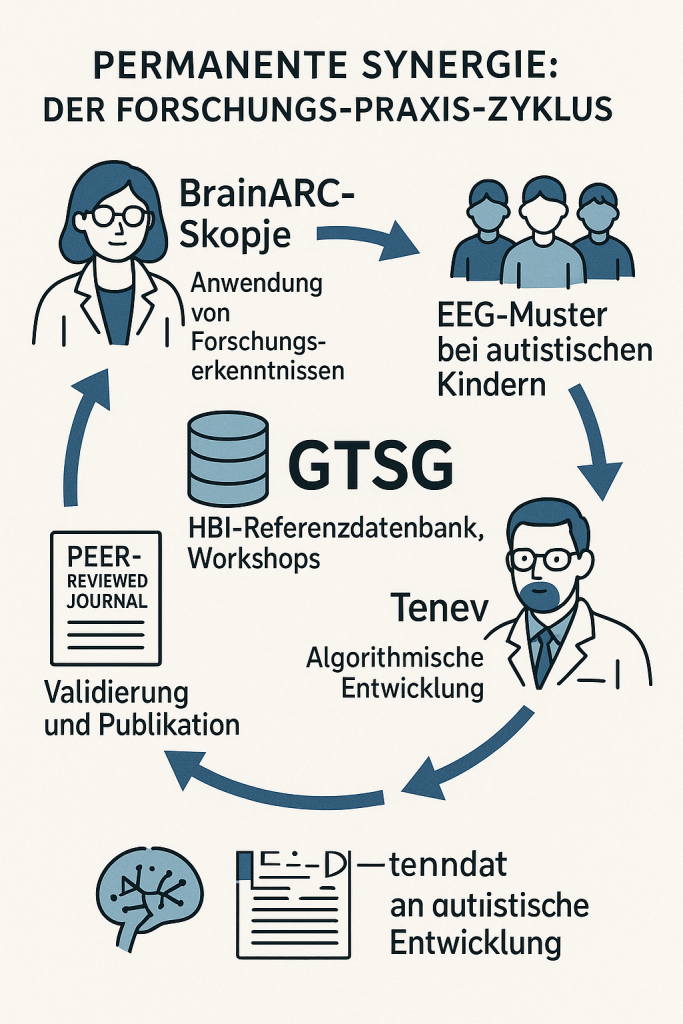
A concrete example: if Markovska-Simoska observes an EEG pattern in autistic children, Tenev develops algorithms to quantify it objectively. These are validated on the cohort, published in peer-reviewed journals and fed back into clinical practice – not only in Skopje, but worldwide via GTSG networks.
The decisive breakthrough: autism biomarkers in the HBImed database
The HBImed reference database will soon feature dedicated autism biomarker modules – a development that the GTSG is substantially helping to steer. This marks the transition from research projects to a globally standardised diagnostic instrument.
The new modules include: automated subtype identification based on Tenev’s machine-learning models (epileptiform activity, mu rhythm, beta spindles, coherence anomalies, delta excess, alpha anomalies); quantitative entropy and complexity analyses of all validated measures with normative comparison; visual processing signatures through special occipito-parieto-temporal analyses; connectivity mapping of hyper- and hypoconnectivity patterns; neurofeedback protocol recommendations based on the identified subtypes.
Clinicians worldwide – whether in Zurich, Los Angeles or Tokyo – will then be able to carry out the same objective, scientifically validated analyses that Markovska-Simoska developed in Skopje. The GTSG coordinates between HBI database development, the Skopje researchers and clinical implementation.
The GTSG as an implementation catalyst
The decisive difference between research that gathers dust in journals and findings that improve patients’ lives is systematic implementation. As a non-profit foundation, the GTSG translates neurobiological research into clinically effective interventions. The BrainARC networks act as implementation platforms for scientifically validated methods.
The annual Biomarker Workshop – held for the 14th time in 2025 – is much more than a conference: it is a place of knowledge transfer where leading researchers pass on their findings directly to practising clinicians. The 80 on-site participants and international online viewers carry the findings into their practices, creating a global network that practises objective biomarker diagnostics as a clinical standard.
Scientific validity through independent replication
Independent replication is the gold standard of scientific validity. The theta/beta ratio in ADHD is a cautionary example: meta-analyses showed a negative correlation (r = −0.97) between year of publication and effect size – a sign of publication bias.
Autism subtyping stands on firmer foundations: the fact that Linden/Gunkelman and Markovska-Simoska independently developed very similar typologies is strong evidence of their validity. Tenev’s algorithmic validation (97.7% accuracy) adds a further layer of evidence: if machine learning based exclusively on objective EEG metrics can distinguish between autistic and neurotypical children, these are robust, quantifiable neurophysiological differences.
Skopje as an international research centre
For a country of 2 million inhabitants, Skopje’s international visibility is remarkable. The explanation: interdisciplinary excellence (Markovska-Simoska’s clinical expertise meets Tenev’s algorithmic competence); institutional support from the Academy and EU COST Actions; a 15-year clinical database at the BrainARC practice; international collaborations with the GTSG and access to the HBI database; a strategic publication culture in high-impact journals such as Frontiers in Psychiatry and Brain Sciences.
Conclusion: the future begins now
The collaboration between Skopje and the GTSG exemplifies how international networks, interdisciplinary expertise and research-practice synergy are transforming autism diagnostics. The forthcoming HBImed integration – co-steered by the GTSG and based on the research of Markovska-Simoska and Tenev – translates decades of work into a globally available tool.
The 14th Biomarker Workshop marks a milestone: the convergence of independently developed typologies, algorithmic validation and clinical implementation demonstrates that objective, neurobiologically grounded autism diagnostics is not a distant prospect. It is already happening – in Skopje, in BrainARC practices in Switzerland, in research laboratories worldwide. The HBImed integration democratises this vision. As a strategic catalyst, the GTSG connects scientific excellence with clinical implementation.
The message is clear: the future of autism diagnostics is objective, personalised and scientifically grounded. And this future begins now.
Biomarker Workshop 2025: Neurophysiological Recognition and Implementation
11. December 2025 | Paulus Akademie, Zurich | Hybrid format
Experience the presentation by Prof. Dr Silvana Markovska-Simoska and Dr Aleksandar Tenev on implementing objective neurophysiological biomarkers in clinical practice.
Registration: https://gtsg.ch/en/biomarker-workshop-2025/
GTSG – Brain and Trauma Foundation Grison
Schulstrasse 1, 7302 Landquart | Phone: +41 81 322 2828