Neurobiological precision in clinical practice: Dr Corinne Henzen and the integration of objective markers
BrainARC Zürich occupies a special position in Switzerland’s psychiatric care landscape. The competence centre, with 14 highly qualified specialists from psychology, neuropsychology, medicine and administration, is consistently committed to an integrative approach: combining traditional clinical expertise with objective neurobiological measurements. This “both/and” approach marks the paradigm shift that the Biomarker Workshop 2025 brings into focus.
Dr Corinne Henzen embodies this bridge in her daily work. As partner and managing director of BrainARC Zürich, she works with adults and children and brings years of experience in the practical application of neurobiological diagnostics. Her talk on 11 December 2025 bears the programmatic title: “From case vignette to neurobiology: the cingulate system and hypersensitivity as transdiagnostic markers in autism, anxiety disorders and ADHD”.

The cingulate system: the neurobiological centre of overlapping symptoms
The cingulate system – consisting of the anterior, middle and posterior cingulate cortex – acts as a neurobiological hub in which cognitive control, emotional processing and autonomic regulation converge. Research in recent years has revealed remarkable findings: structural and functional abnormalities in this system are found consistently in ADHD, autism spectrum disorders and anxiety disorders.
ADHD: volume reduction and impaired impulse control
In ADHD, imaging studies show significant volume reductions and cortical thinning in the anterior cingulate cortex (ACC), especially in the right rostral ACC. These changes correlate directly with symptom severity: the thinner the cortex, the more pronounced the symptoms. The anterior midcingulate cortex (aMCC) plays a central role in impulse control and cognitive tasks such as Go/No-Go tests, the Stroop test and the Wisconsin Card Sorting Test – precisely those functions that are impaired in ADHD.
Functional connectivity shows a characteristic pattern: increased local connections of the amygdala together with reduced connections between the ACC and the posterior cingulate cortex. Neurobiologically, this means that people with ADHD react impulsively to the emotional significance of stimuli without cortical inhibition taking effect – the neural correlate of the clinically observable impairment of impulse control.
Autism: cellular changes and social processing
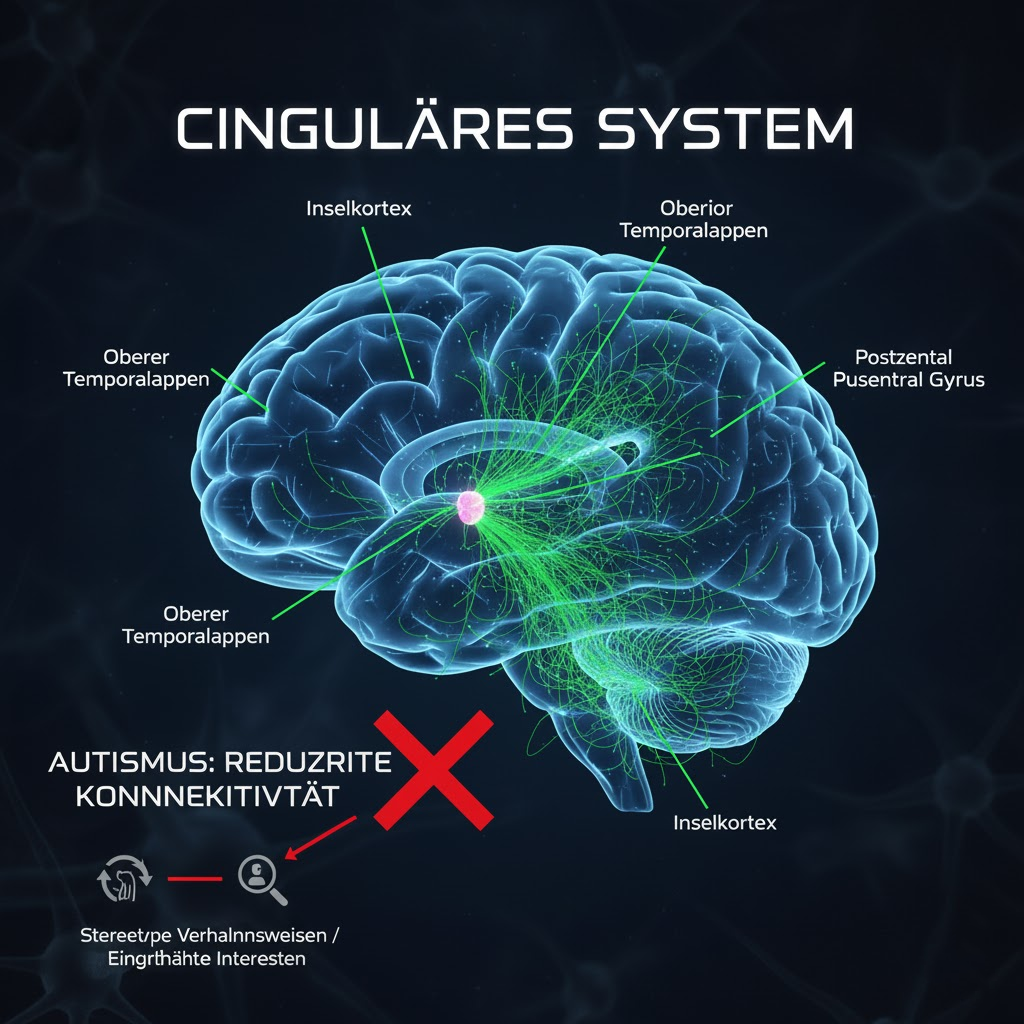
In autism spectrum disorders, post-mortem studies document significant cellular changes in the ACC: reduced cell size in layers I–III and V–VI and irregular lamination in a third of the autistic brains examined. Functionally, there is reduced connectivity between the caudal ACC and regions central to social processing – the insular cortex, the superior temporal lobe and the postcentral gyrus. Notably, the strength of this connectivity correlates negatively with stereotyped behaviours and restricted interests.
Anxiety disorders: dysregulation of emotional appraisal
Anxiety disorders also manifest in dysfunctions of the cingulate system. The ACC is critical for appraising emotional significance and regulating autonomic responses – precisely the processes that are dysregulated in anxiety disorders. The overlap becomes particularly clear when the high comorbidity rates are taken into account: 40–60% of autistic people show comorbid anxiety disorders, while anxiety is also clearly over-represented in ADHD.
Hypersensitivity: the transdiagnostic marker
Henzen sees hypersensitivity not as an illness but as a transdiagnostic marker – a perspective increasingly supported by recent research. Hypersensitivity describes a lower threshold for sensory processing that leads to faster overstimulation and more intense perception. This phenomenon is found across diagnostic boundaries in ADHD, autism and anxiety disorders – albeit with subtle but important differences in its expression.
Neurobiological foundations of stimulus filtering
Neurobiologically, hypersensitivity can be traced back to dysfunctions in stimulus filtering. The thalamus acts as the central filter that regulates which incoming stimuli are passed on to the prefrontal cortex for further processing. In ADHD, a dopamine deficit in the striatum leads to impaired control of the thalamus – the result is a stimulus filter that is “too open” and does not adequately differentiate between relevant and irrelevant stimuli.
In autism, hypersensitivity manifests already at early stages of stimulus processing. The threshold for sensory overload is considerably lower than in neurotypical people. Various studies show a link between sensory over-responsivity and fear of change: autistic people find it difficult to use previous experience when processing new sensory information, which makes new sensory impressions more intense and potentially more overwhelming.
Heart rate variability (HRV) reveals opposing autonomic profiles that are diagnostically relevant: ADHD typically shows hypoarousal patterns with reduced HRV, while autism shows context-dependent hyperarousal patterns. These different arousal profiles have direct therapeutic implications and underline the need for objective measurements for differentiation.
From case vignette to neurobiology: the practical added value
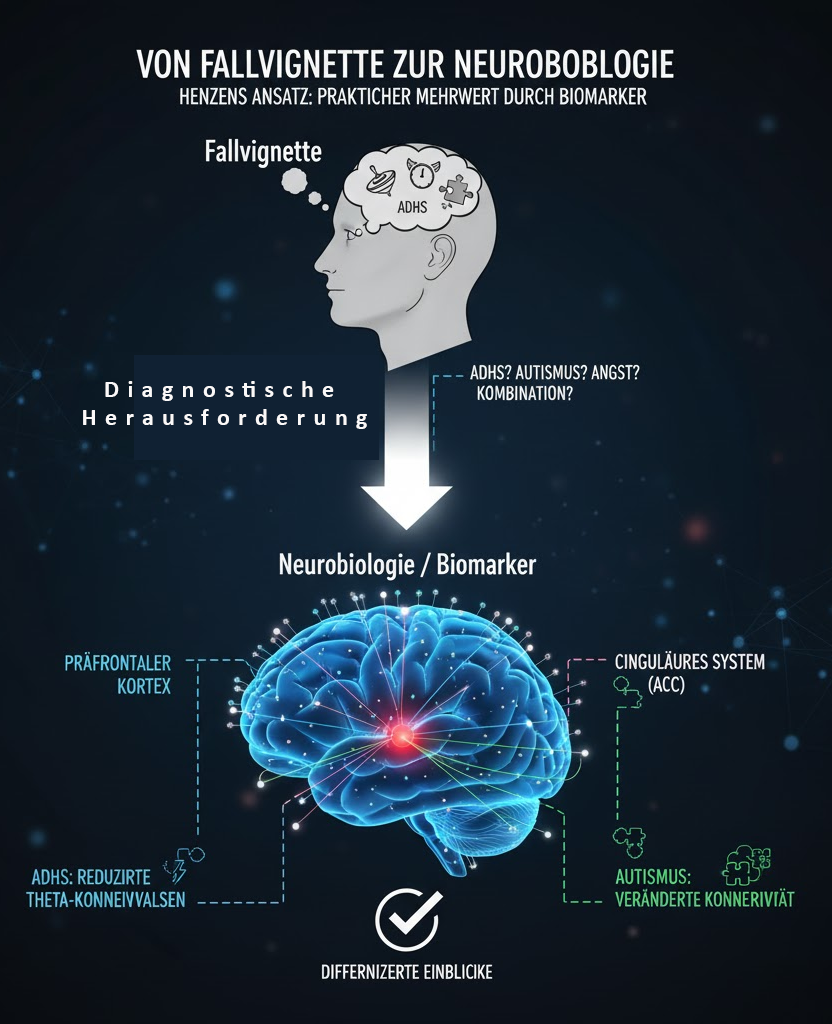
Henzen’s approach of starting from concrete case vignettes to uncover the neurobiological mechanisms embodies the core of biomarker integration into clinical practice. The diagnostic challenge in adult psychiatry often lies in the complexity of overlapping symptoms: is the marked sensory overload an expression of ADHD, autism, an anxiety disorder – or a combination?
Objective markers of the cingulate system offer differentiated insights here. EEG-based connectivity analyses can identify specific patterns of dysfunction: reduced theta connectivity between the ACC and the prefrontal cortex points primarily to ADHD, while changes in connectivity between the ACC and temporal regions are more indicative of autism spectrum disorders.
Therapeutic consequences
The transdiagnostic perspective on hypersensitivity enables personalised therapeutic interventions:
- In ADHD-associated hypersensitivity, stimulant medication can paradoxically help by improving stimulus filtering
- Autism-associated sensory over-responsivity tends to require environmental modifications and specific sensory integration therapies
- Anxiety-driven hypersensitivity responds primarily to adapted cognitive behavioural therapy and, where appropriate, anxiolytic medication
Integration into clinical routine: BrainARC’s model
BrainARC Zürich demonstrates how neurobiological biomarkers can be integrated into routine care. The approach rests on three pillars: first, comprehensive neuropsychological assessments that capture cognitive profiles in detail. Second, EEG-based brain function analyses that provide objective markers of attention, impulse control and emotional processing. Third, the integration of these data into a clinical context by experienced professionals who take both neurobiological and psychosocial factors into account.
This approach transforms the diagnostic uncertainty that has traditionally characterised psychiatry. Instead of having to rely on kappa values of 0.28–0.32 for major depression – which means that over 85% of diagnostic decisions do not agree between different professionals – objective markers enable reproducible, evidence-based diagnostics.
This is particularly relevant for adult patients. Many come after decades-long diagnostic odysseys, multiple misdiagnoses and unsuccessful attempts at therapy. Objective confirmation through neurobiological markers – “the EEG really does show the stimulus-filtering impairment you describe” – can be transformative: it validates subjective experiences, reduces self-doubt and creates a sound basis for tailored interventions.
The paradigm shift: from categories to dimensions
Henzen’s focus on transdiagnostic markers reflects a fundamental paradigm shift in psychiatry: away from rigid diagnostic categories towards dimensional models that do greater justice to neurobiological reality. The NIMH’s Research Domain Criteria (RDoC) framework embodies this approach by examining functional domains across diagnostic boundaries.
The cingulate system and hypersensitivity are exemplary transdiagnostic dimensions. The genetic overlap of 50–72% between ADHD and autism, shared risk genes such as MAP1A and converging neurobiological mechanisms speak a clear language: these disorders represent a continuum rather than discrete categories.
For clinical practice, this means: treat not the diagnosis, but the underlying functional dysfunctions. If objective markers show a dysfunction of the cingulate system that leads to impulse control problems, the specific diagnostic classification is less relevant than the fact that this dysfunction can be addressed therapeutically – whether through medication, neurofeedback or cognitive strategies.
The workshop contribution: practical implementation
On 11 December 2025 at 3.30 pm, Henzen will make this perspective concrete in her talk. Its strength lies in combining theoretical foundations with practical application: starting from case vignettes from clinical routine at BrainARC, she will demonstrate how neurobiological data contribute to diagnostic clarification and treatment planning.
Its place in the day’s programme has been chosen strategically: after the talks on practical biomarker applications (Müller), the in-depth clinical insights of Attwood/Garnett and the neurophysiological foundations from Markovska/Tenev, Henzen’s contribution offers a neurobiological deepening of specific mechanisms. Together with Matthias Huber’s personal perspective (“Understanding therapy from within”) and Birgit Graf’s integration into child and adolescent psychiatry, a comprehensive picture of biomarker implementation emerges across age groups and care settings.
Outlook: the future of personalised psychiatry
The work of BrainARC Zürich and professionals such as Corinne Henzen points the way to the future of psychiatric care: personalised medicine based on objective neurobiological profiles. The cingulate system as a transdiagnostic hub and hypersensitivity as an overarching phenomenon illustrate that the complexity of mental disorders can be resolved not by forming further categories but by a deeper understanding of the underlying mechanisms.
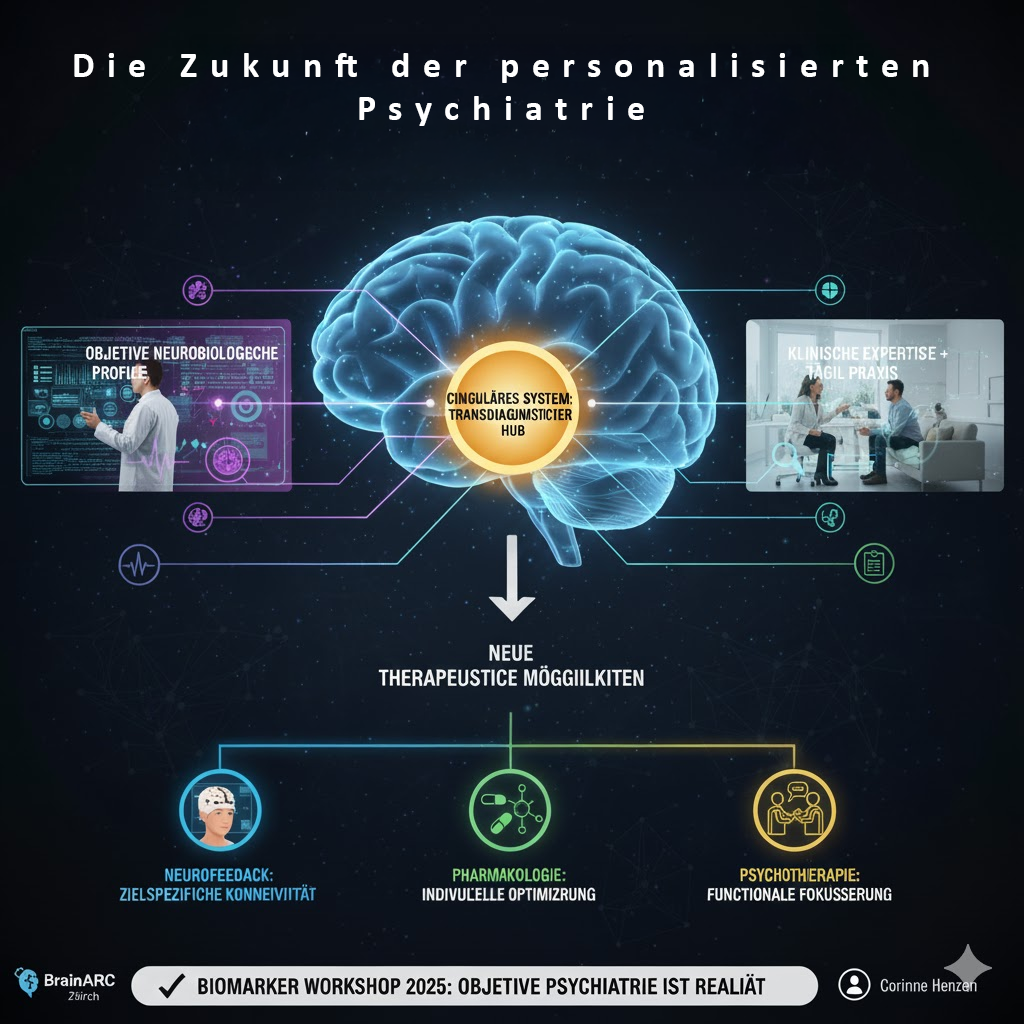
Integrating objective biomarkers not only creates diagnostic certainty but also opens up new therapeutic possibilities: neurofeedback protocols that specifically address the connectivity of the cingulate system show promising effects in ADHD. Pharmacological interventions can be optimised on the basis of individual neurobiological profiles. Psychotherapeutic approaches can be aligned more precisely with specific functional deficits.
The Biomarker Workshop 2025 marks a decisive step in spreading these integrative approaches. Henzen’s contribution demonstrates that the vision of objective psychiatry is already a reality – not in distant research laboratories, but in the daily clinical practice of a Swiss competence centre that consistently combines brain function and clinical expertise.
Biomarker Workshop 2025: ADHD-Autism-Anxiety-Sensitivity
“Diagnostics: from vision to reality”
Thursday, 11 December 2025: 9.00 am–5.30 pm
Paulus Akademie, Zurich
3.30 pm: Dr Corinne Henzen
“From case vignette to neurobiology: the cingulate system and hypersensitivity as transdiagnostic markers in autism, anxiety disorders and ADHD”
Registration: https://gtsg.ch/en/biomarker-workshop-2025/
Participation fee: CHF 150.–
Credits: 7
Brain and Trauma Foundation Grison
Phone: +41 81 322 28 28