Psychiatric diagnostics is facing a paradigm shift. While for decades we have tried to fit our patients into clearly delineated diagnostic categories – ADHD, autism, anxiety disorder, hypersensitivity – current research paints a completely different picture: these conditions overlap massively. The sharp boundaries suggested by our diagnostic manuals do not exist in reality. What we should be diagnosing are not categories but neurobiological patterns.

Dr Corinne Henzen, BrainARC-Zürich
The limits of categorical diagnostics
Imagine two children who both receive a diagnosis of ADHD. One child is highly sensitive to noise and light, prone to emotional meltdowns and has marked difficulties in social situations. The other child is impulsive, constantly seeks sensory stimulation and has problems above all with impulse control. Both have “ADHD” – but is it really the same disorder? And would both benefit from the same treatment?
The answer is no. And this is exactly where the problem with our current, purely categorical diagnostics lies. The DSM-5 and ICD-11 criteria represent historically evolved constructs, not neurobiological realities. Research in recent years clearly shows that ADHD, autism, anxiety disorders and hypersensitivity share substantial genetic, neurobiological and phenomenological commonalities. The transitions are fluid, and comorbidity rates are alarmingly high.
National data from the USA show that around 40% of children with ADHD have a comorbid anxiety disorder. In children with autism spectrum disorders, anxiety symptoms range between 40–50% in many studies, and 62.7% show elevated ADHD symptoms. In population studies, around 30–50% of people with autism also show clinically relevant ADHD symptoms. These figures are not statistical outliers – they reveal a systematic problem with our diagnostic categories.
The dimensional approach: four transdiagnostic axes
The solution lies in a dimensional approach that diagnoses not along DSM pigeonholes but along neurobiological dimensions that cut across all conditions. The idea is not new: RDoC, a system developed by the NIMH and intensively discussed in the USA, already represents the dimensional perspective. These four dimensions can be captured and quantified objectively both by means of questionnaires and interviews and, on an evidence-based footing, by biomarkers.
AXIS 1: Sensory processing & arousal regulation
The sensory dimension is the most obvious common denominator. Sensory over-responsivity (SOR) is by no means a phenomenon specific to autism, but transdiagnostic:
- In autism, sensory particularities are almost a core feature – both over- and under-sensitivity to light, sounds, touch and smells
- People with ADHD show significantly increased “sensory sensitivity”, “sensory avoidance”, “sensory seeking” and “low registration”
- In anxiety disorders, SOR is systematically associated with higher levels of anxiety
- Highly sensitive persons (SPS – sensory processing sensitivity) by definition show increased sensory reactivity, in around 20–30% of the population
The neurobiological markers of this dimension include P50 suppression (sensory responsiveness), early sensory components such as P1/N1, gamma power (stimulus filter indicators) and arousal and, in part, vigilance regulation – not specific to ADHD!
In a visualisation, this can be represented as follows:
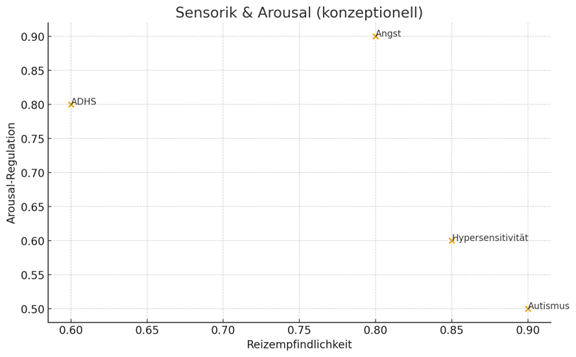
Figure 1: Distribution of the four conditions on the dimension “sensory processing & arousal”. Autism shows the highest sensitivity to stimuli with unstable arousal regulation, while ADHD tends to combine moderate sensitivity with high (and often also low) arousal.
AXIS 2: Emotional reactivity & anxiety systems
Emotional dysregulation and anxiety are not a side detail but a common transdiagnostic factor. Research shows:
- Comorbid anxiety disorders in ADHD: 18–25% in clinical samples, up to 40% in broader surveys
- In autism, anxiety symptoms range between 40–50%
- SOR is directly associated with higher levels of anxiety – regardless of the primary diagnosis
- Sensory processing sensitivity (SPS) is by definition linked to increased emotional responsiveness
The neurobiological markers include the conflict-monitoring component, frontal midline theta (emotional control effort), alpha asymmetry (right vs. left frontal area) and the late positive potential (LPP).
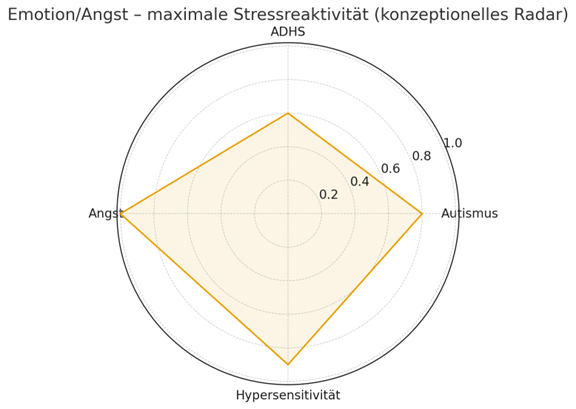
Figure 2: On the emotional dimension, anxiety disorders show the highest stress peaks, followed by hypersensitivity. Autism lies in the upper range, while ADHD tends to show moderate, broad over-arousal.
AXIS 3: Executive functions & attentional control
This is formally ADHD’s “home ground”, but the data have long been transdiagnostic. Reviews from a transdiagnostic perspective show that deficits in attention, inhibition, working memory and cognitive flexibility occur across ADHD, autism and anxiety disorders:
- ADHD: high distractibility, inhibition problems, impulsive reactions
- Autism: weaknesses in flexibility and planning, but an attentional focus that is “rigid” rather than “scattered”, excessive focusing.
- Anxiety disorders: attentional focus on danger, perseverative rumination, functional blockages
- Hypersensitivity: sensory overload leads to attentional collapse – secondary overload, not a primary EF disorder
The markers include P3a/P3b amplitudes (engagement, working memory), N2 (inhibition), CNV (preparatory processes), microstate class D (fronto-cognitive networks) and the beta/theta ratio (top-down control).
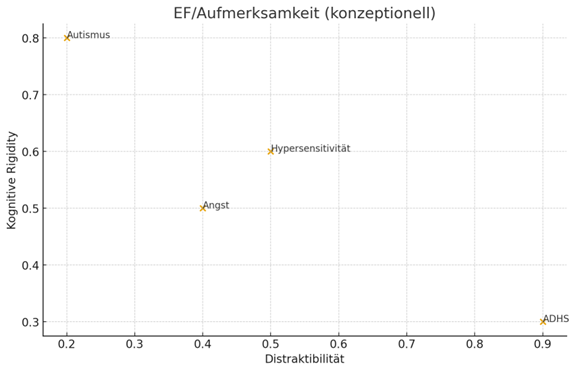
Figure 3: ADHD shows the highest distractibility on the EF dimension, while autism shows more rigid attentional patterns. Anxiety and hypersensitivity lie in the middle range.
AXIS 4: Social information processing & social cognition
The social dimension shows the differences between the conditions particularly clearly:
- Autism: weaknesses in social cognition, theory of mind, face processing (N170), high strain from social stimuli
- ADHD: impulsive social errors, limited perspective-taking, but no fundamental ToM impairment
- Anxiety disorders: social avoidance, over-interpretation of threat, but no neurocognitive deficits
- Hypersensitivity: high affective empathy, strong emotional resonance, social exhaustion – but no ToM impairment
The markers include microstate class B (default/social brain), N170 (face processing), N250, LPP to social stimuli and temporo-parietal gamma connectivity.
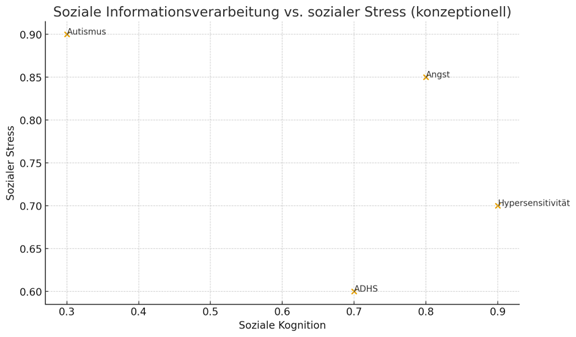
Figure 4: Autism shows low social cognition with high social stress. Anxiety and hypersensitivity have intact social cognition but high social stress. ADHD lies in the middle.
The overall picture: massive overlap instead of clear boundaries
When we combine all four dimensions, the extent of the overlap becomes clearly visible. The following radar chart shows the typical profiles:
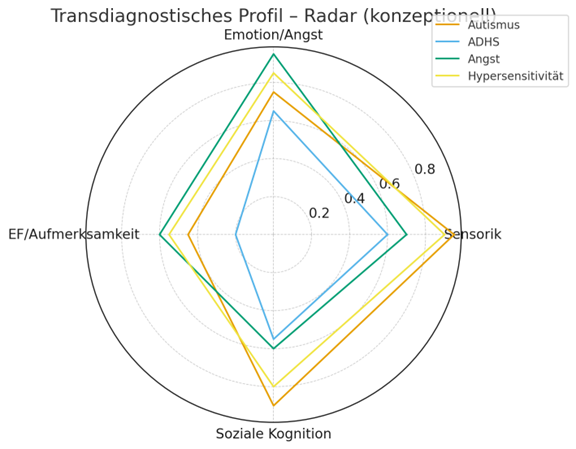
Figure 5: The overall picture – four dimensions, four typical patterns, massive overlap. Autism shows high sensory and social peaks, ADHD high EF deficits, anxiety dominant emotional peaks, and hypersensitivity high sensory and emotional values with intact EF and social cognition.
Practical relevance: what does this mean for the clinic?
This dimensional perspective has immediate clinical consequences:
1. More precise diagnostics: Instead of asking “Does this patient have ADHD or autism?”, we ask “What profile does this patient show on the four dimensions?” EEG-based biomarkers provide objective, quantifiable data for each dimension.
2. Personalised treatment: A child with ADHD + high sensory over-responsivity + a strong anxiety component needs completely different treatment from a child with ADHD + sensory seeking + low emotional dysregulation. Dimensional diagnostics makes tailored interventions possible.
3. Understanding comorbidities: The high comorbidity rates are not diagnostic ambiguities but an expression of shared neurobiological foundations. When 40–50% of autism patients also meet ADHD criteria, this is no coincidence – it shows that both disorders overlap on the dimensions of sensory processing, emotion and EF.
4. Treating “hypersensitivity”: SPS/high sensitivity is not a disorder but a temperamental variant with increased sensory and emotional reactivity. Many highly sensitive people meet neither ADHD nor autism criteria, but benefit from the same sensory interventions and emotional regulation strategies.
The role of objective biomarkers
Dimensional diagnostics only works with objective, quantifiable markers. This is where complementary biomarkers come into play. They capture:
- Sensory processing directly via early components (P50, P1/N1, gamma)
- Emotional regulation via frontal midline theta, alpha asymmetry, LPP
- Executive functions via P3, N2, CNV, beta/theta ratio
- Social cognition via N170, microstate class B, social ERP components
These markers have decisive advantages: they are direct (no behavioural observation), quantifiable (no subjective assessment), reproducible (standardised protocols) and cost-efficient (existing clinical infrastructure).
Conclusion: from categorical to dimensional thinking
The scientific evidence is overwhelming: ADHD, autism, anxiety disorders and hypersensitivity are not separate islands but overlap massively at the sensory, emotional, executive and neurobiological levels. The genetic correlation between ADHD and autism lies at 0.35–0.50. Transdiagnostic symptom dimensions explain the variance better than categorical diagnoses.
The future of psychiatric diagnostics lies not in ever finer subcategories, but in the precise mapping of neurobiological dimensions. Biomarkers help us recognise these patterns objectively. We do not diagnose categories but patterns – and we treat people, not labels.
Biomarker Workshop 2025: dimensional diagnostics in practice
On 11 December 2025 our 14th Biomarker Workshop will take place in Zurich (hybrid). The topic: ADHD-Autism-Anxiety-Sensitivity – spectrum or comorbidity?
International experts demonstrate the practical implementation of dimensional diagnostics:
9.00 am – 5.30 pm
- Tony Attwood & Michelle Garnett (Keynote): «Beyond the Stereotypes: Biomarkers for the Hidden Presentations of Autism, ADHD, and Anxiety – Insights from 80 Years of Clinical Practice»
- Andreas Müller: “From vision to reality: practical biomarker applications”
- Nicole Chou: PDA profiles – Persistent Drive for Autonomy
- Silvana Markovska & Alexander Tenev (Skopje): Neurophysiological implementation in clinical practice
- Matthias Huber: Understanding therapy from within – lived experience as a resource
- Corinne Henzen: The cingulate system and hypersensitivity as transdiagnostic markers
- Birgit Graf: Integration into child and adolescent psychiatry
Cost: CHF 150.– | Credits: 7 | Venue: Paulus Akademie Zurich (hybrid)
GTSG – Brain and Trauma Foundation Grison
Schulstrasse 1, 7302 Landquart | Phone: +41 81 322 28 28 | www.gtsg.ch