
ADHD – Autism – Anxiety – Hypersensitivity – PDA
Brain and Trauma Foundation Grison (GTSG)
Supplementary material for the Biomarker Workshop 2025 | 11 December 2025, Zurich
Introduction: from pathology to an evolutionary perspective
Modern neuroscience is beginning to understand that many conditions classified as “disorders” may have evolutionary origins. As Yuval Noah Harari describes in “Sapiens”, humans lived for more than 95% of their existence as hunter-gatherers in small, egalitarian groups. The neurobiological variations we know today as ADHD, autism, anxiety disorders, hypersensitivity and PDA may have offered adaptive advantages in these contexts.
This approach does not replace clinical diagnostics but complements it with an appreciative perspective that understands neurodivergent people not as “defective” but as carriers of evolutionarily significant traits.
1. The Hunter – ADHD, hyperactive-impulsive type
Evolutionary function
The hunter/farmer hypothesis, developed by Thom Hartmann in the 1990s, positions the hyperactive-impulsive ADHD type as the “hunter” – an individual whose neurological traits were optimised for survival in prehistoric hunting contexts.
Core traits and their adaptive significance
Impulsivity: Rapid decision-making without lengthy deliberation – vital in the hunt when prey flees.
Hypervigilance: Constantly scanning the environment for movements, sounds and dangers – essential for successful hunting and avoiding predators.
Risk-taking: Willingness to face danger for potential rewards – necessary for hunting big game.
Hyperfocus: Intense concentration on moving targets – critical for successful pursuits.
2. The Gatherer/Dreamer – ADHD, inattentive type
Evolutionary function
The inattentive ADHD type – often described as a “dreamer” or “dreamy” – does not fit the classic hunter pattern. Instead, these traits may have been optimised for gathering and creative problem-solving.
Core traits and their adaptive significance
Broad attention: Diffuse perception of the environment – ideal for spotting edible plants, mushrooms and fruits in complex landscapes.
Daydreaming: Mental simulation and creative thinking – enables innovation and new approaches to solutions.
Patience: The ability to wait and observe – essential for gathering and for crafts.
3. The Specialist (Solitary Forager) – autism spectrum
Evolutionary function
In 2011, Jared Reser formulated the “Solitary Forager Hypothesis”: autistic traits could represent adaptations to a way of life as a lone hunter or specialised gatherer operating independently of the main group.
Penny Spikins and colleagues at the University of York argued in 2016 that autistic traits may have contributed to humanity’s evolutionary success, particularly through specialised knowledge and innovative problem-solving.
Core traits and their adaptive significance
Special interests: Deep expert knowledge in specific areas – made individuals indispensable holders of knowledge for toolmaking, navigation and medicine.
Pattern recognition: A superior ability to recognise patterns and deviations – critical for tracking, weather forecasting and identifying resources.
Social independence: Less need for social approval – enabled autonomous work and unconventional thinking.
4. The Sentinel – anxiety disorders
Evolutionary function
In 2011, Randolph Nesse described the “smoke detector principle”: anxiety is an evolutionary alarm system calibrated towards false-positive alarms, because the cost of missing a predator (death) far exceeds the cost of a false alarm (wasted energy).
Core traits and their adaptive significance
Hypervigilance: Constantly scanning for danger – made these individuals ideal night watchmen and scouts.
Anticipatory anxiety: Foreseeing possible problems – enabled preventive planning and provision of resources.
Social sensitivity: A fine sense for group dynamics and potential conflicts – important for group harmony.
5. The Environmental Detector (Canary) – hypersensitivity
Evolutionary function
In 1996, Elaine Aron coined the concept of the “Highly Sensitive Person” (HSP) and argued that sensory processing sensitivity represents an evolutionary strategy – the “pause-to-check” strategy, which occurs in 15–20% of all higher animal species.
Core traits and their adaptive significance
Sensory fine-tuning: Perceiving subtle changes in the environment – an early warning of shifts in the weather, predators or contaminated water.
Emotional resonance: Deeply sensing the moods of others – enabled early recognition of tensions within the group.
Deep information processing: Thinking things through thoroughly before acting – prevented hasty mistakes in dangerous situations.
6. The Sovereign – PDA profile
Definition and background
PDA (Pathological Demand Avoidance) was first described in the 1980s by Professor Elizabeth Newson at the University of Nottingham. She identified a group of children with an “obsessive avoidance of the ordinary demands of everyday life” (Newson et al., 2003, Archives of Disease in Childhood). Today, PDA is often renamed “Pervasive Drive for Autonomy”, which better captures the core of the profile.
Nicole Chou will explore exactly this topic in depth at the Biomarker Workshop 2025: “PDA – Pathological Demand Avoidance or Persistent Drive for Autonomy”.
Evolutionary function: the anti-hierarchy detector
The evolutionary perspective on PDA emerges from anthropological research on hunter-gatherer societies. In “Hierarchy in the Forest” (1999), Christopher Boehm described the phenomenon of the “reverse dominance hierarchy”: hunter-gatherer societies were actively egalitarian and systematically resisted every form of dominance.
Peter Gray, developmental psychologist at Boston College, documented in Psychology Today in 2011: “As part of their egalitarianism, they have an extraordinary respect for individual autonomy. They don’t tell one another what to do.” He described hunter-gatherers as “fiercely egalitarian”.
A study by Thomson et al. published in 2025 in the Journal of Cross-Cultural Psychology confirmed: “In all three immediate-return groups, individuals formed morally united coalitions to collectively suppress hierarchical behaviour.”
Core traits and their adaptive significance
Intense need for autonomy: According to research, the core trait of PDA is an “intense and pervasive need for personal freedom and self-determination” (Wilding, 2022). Evolutionarily: protection against exploitation by dominant individuals.
Fight-flight-freeze in response to demands: According to PDA North America, PDA individuals show “highly sensitive neuroception that triggers a trauma response to perceived threats that are not obvious to others”. Evolutionarily: an early-warning system against social manipulation and coercion.
Social strategies for avoidance: People with PDA use distraction, negotiation and role play – not passive refusal. Evolutionarily: diplomatic forms of resistance that preserve group harmony.
Awareness of equality: Newson observed that children with PDA often show “no normal sense of social identity” and feel “on an equal footing with, or superior to, adults”. Evolutionarily: a reflection of the egalitarian norms of hunter-gatherer societies, in which adults had no automatic authority over children.
The historical context: from egalitarianism to hierarchy
As Harari describes in “Sapiens”, the agricultural revolution around 10,000 years ago brought fundamental changes: fixed structures, hierarchies, chains of command, expectations of conformity. The PDA profile could represent a neurobiological “remnant” of egalitarian primal instincts – a warning system against submission to the demands of others that was highly adaptive in hunter-gatherer times.
Anthropological research shows that hunter-gatherer societies used active “levelling mechanisms” – ridicule, exclusion, even exile – against anyone who tried to dominate others (Boehm, 1993). People with a PDA profile may have been those who triggered these levelling mechanisms most sensitively and enforced them most actively.
Neurobiological correlates
PDA is associated with a highly sensitive autonomic nervous system. The Reframing Autism organisation describes: “Individuals with PDA may display a fight, flight or freeze response when faced with demands that threaten their independence.”
This autonomic hypersensitivity – measurable through EEG-based biomarkers and heart rate variability – could be the biological expression of this evolutionary “sovereignty detector”. Integrating such biomarkers into diagnostics is a central topic of the Biomarker Workshop 2025.
7. Integration: the neurodivergent ecosystem
These six archetypes did not exist in isolation but formed a complementary ecosystem within prehistoric groups:
The Hunter (ADHD-H): Active food procurement, defence against predators
The Gatherer (ADHD-I): Identifying resources, creative innovation
The Specialist (ASD): Technical knowledge, toolmaking, pattern recognition
The Sentinel (anxiety): Detecting danger, planning, social harmony
The Environmental Detector (HSP): Early warning, emotional intelligence, quality control
The Sovereign (PDA): Protection against hierarchisation, preserving equality within the group, resistance to exploitation
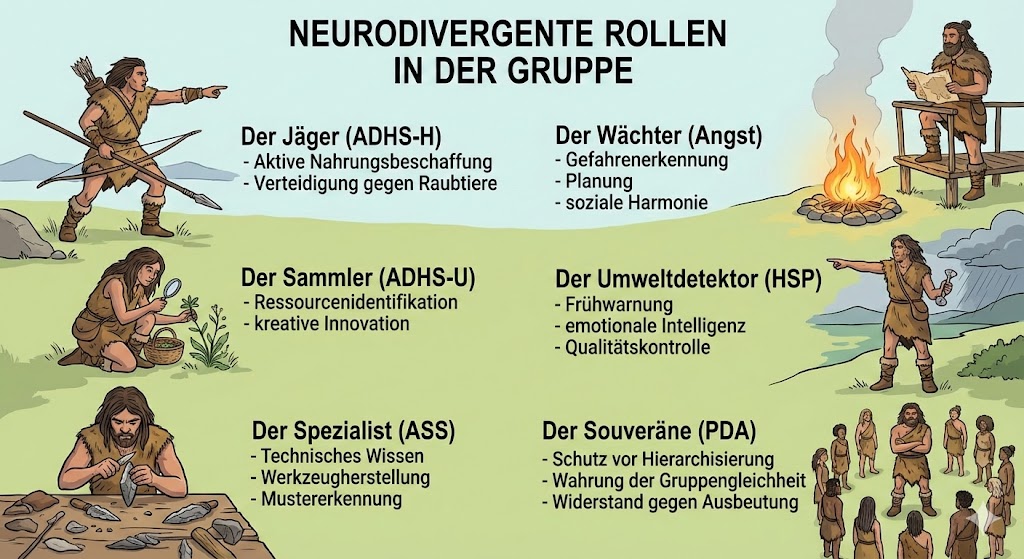
This perspective does not replace clinical diagnostics, but it offers an appreciative framework: neurodivergence not as a defect, but as a diversity of evolutionarily optimised cognitive strategies.
References
Aron, E.N. (1996). The Highly Sensitive Person: How to Thrive When the World Overwhelms You. Broadway Books.
Boehm, C. (1993). Egalitarian Behavior and Reverse Dominance Hierarchy. Current Anthropology, 34(3), 227-254.
Boehm, C. (1999). Hierarchy in the Forest: The Evolution of Egalitarian Behavior. Harvard University Press.
Gray, P. (2011). How Hunter-Gatherers Maintained Their Egalitarian Ways. Psychology Today.
Gray, P. (2019). The Play Theory of Hunter-Gatherer Egalitarianism. Psychology Today.
Harari, Y.N. (2011). Sapiens: A Brief History of Humankind. Harvill Secker.
Hartmann, T. (1993). Attention Deficit Disorder: A Different Perception. Underwood Books.
Nesse, R.M. (2011). Anxiety: An Evolutionary Approach. Canadian Journal of Psychiatry, 56(12), 716-726.
Newson, E., Le Marechal, K., & David, C. (2003). Pathological demand avoidance syndrome: A necessary distinction within the pervasive developmental disorders. Archives of Disease in Childhood, 88(7), 595-600. doi: 10.1136/adc.88.7.595
O’Nions, E. et al. (2014). Development of the ‘Extreme Demand Avoidance Questionnaire’ (EDA-Q). Journal of Child Psychology and Psychiatry, 55(7), 758-768.
PDA Society (2025). History of PDA Research. pdasociety.org.uk
Reser, J.E. (2011). Conceptualizing the Autism Spectrum in Terms of Natural Selection and Behavioral Ecology: The Solitary Forager Hypothesis. Evolutionary Psychology, 9(2), 207-238.
Spikins, P. et al. (2016). Autism and human evolutionary success. Time and Mind, 9(4), 323-351.
Thomson, J. et al. (2025). ‘Fiercely Egalitarian’: Thematic Cross-Cultural Analysis Reveals Regularities in the Maintenance of Egalitarianism. Journal of Cross-Cultural Psychology.
Wilding, T. (2022). Pathological Demand Avoidance. tomlinwilding.com
───────────────────────────────────
Biomarker Workshop 2025
11 December 2025 | Zurich (hybrid)
With Tony Attwood, Michelle Garnett, Nicole Chou and other international experts
© 2025 Brain and Trauma Foundation Grison (GTSG)