
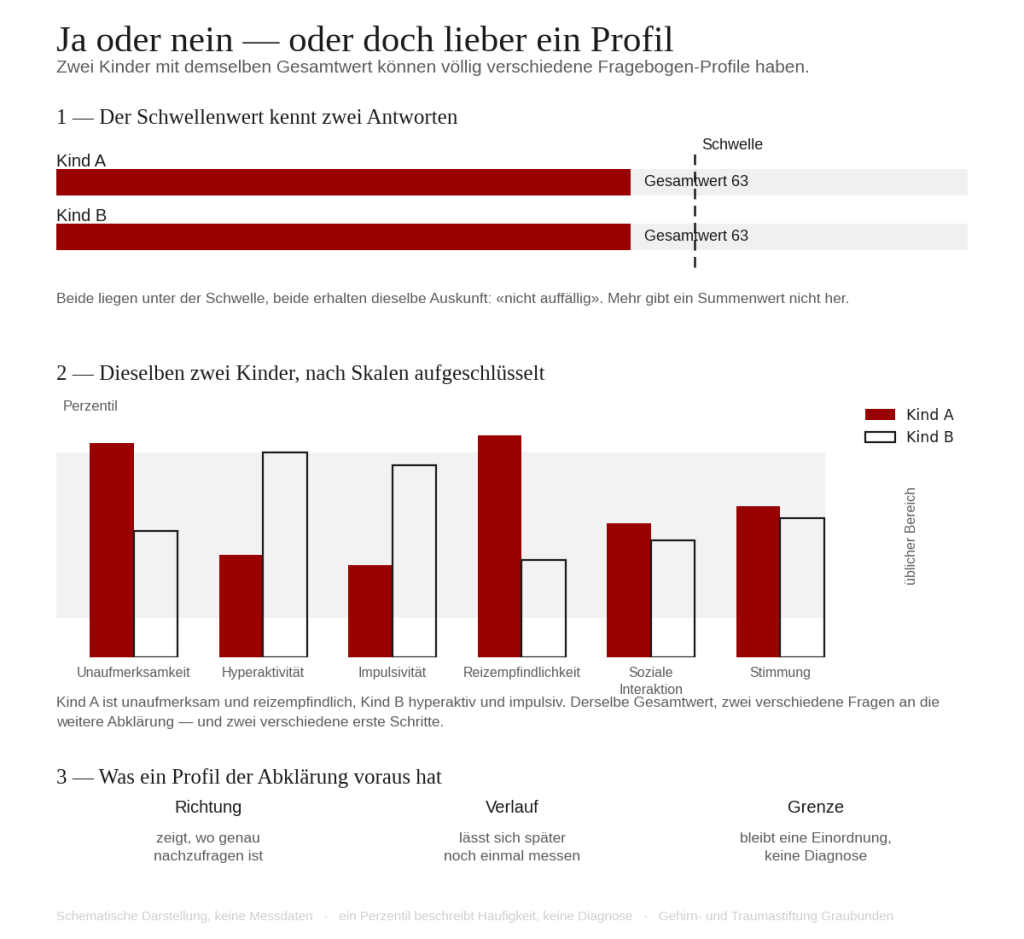
Almost every assessment begins with a questionnaire. Parents tick how often their child loses the thread. Teachers judge how long it stays with a task. Adults answer how much noise bothers them. At the end there is a number — and next to the number a line: the cut-off. Above it means conspicuous, below it means unremarkable.
There is sense in that calculation. A cut-off makes results comparable, it can be documented, and it forces a decision where otherwise impressions would stand. But it answers exactly one question: yes or no. For what has to be done next in an assessment, that is rarely enough.
Two children, the same score
Picture two children who arrive at the same total score, both just below the cut-off. One keeps losing the thread and reacts strongly to noise but sits still. The other pays attention but can hardly put the brakes on and talks across others. The total score offsets these differences against each other: high values in one area are balanced out by low ones in another. What remains is a number that fits both and does justice to neither.
Both families receive the same answer: unremarkable. And both are left with the same question they had before.
What a profile shows
A normed profile goes the other way. It does not add the areas together but keeps them apart and places each one separately — against a comparison group that matches the person’s age. The result is not a number but a pattern: where does this person lie compared with many others, and where does she not?
The pattern makes visible what a cut-off conceals. Which area carries the burden? Do the parents’ and the teacher’s judgements agree, or does the child show a different picture at home than at school? And, most important for the assessment that follows: where is it worth asking precisely?
Why the comparison group decides everything here — and why «normal» does not mean «healthy» — we have described elsewhere in more detail. That diagnoses are in any case less sharply separated than their names suggest, likewise: The Dimension Beneath the Diagnoses.
Three things a profile is not
It is not a diagnosis. A profile describes a position relative to others. What that position means is decided by a professional who brings together history, behaviour, test performance and findings.
It is not immune to chance. Measure many scales and almost every person will show an outlier somewhere. Only a coherent pattern carries a statement — a single extreme value does not.
It remains an account of perception. A questionnaire measures what those affected and the people around them report. That is valuable and limited at the same time. This is why test performance and brain function analysis stand alongside it — three routes that check one another.
Why this is rarely done in practice
The reason is unromantic: time. Done by hand, a single questionnaire costs us in our own practice about ten minutes to prepare and hand out, five minutes to check what comes back, and twenty to forty minutes to score and transfer. That makes 35 to 55 minutes — per questionnaire, per person. These are figures from our own practice, not study values; any professional can check the arithmetic against their own setting.
That time does not go into the assessment but into administration. Anyone wanting to use several instruments — and a profile needs several — quickly arrives at half a working day before anyone is even sitting in the consulting room. And so the choice falls, after all, on the one short questionnaire with the one cut-off.
This is exactly where the HBImed Questionnaire App comes in. The questionnaires are sent out digitally, people fill them in at home, and scoring is automatic and normed. Fifty licensed, clinically established instruments are available today, with a further 25 in preparation. The results can be brought together with test performance and brain function analysis in the same report — and they can be repeated later, which turns a snapshot into a course.
Seeing it in practice
We show how this works in an online session: free of charge, one hour, online. We walk through the whole path once — from sending out the questionnaires to the scored profile — and answer questions.
The next session in German takes place on Monday, 2 November 2026: registration here. A session in English is planned for 1 February 2027; the date will be announced here.
The session lasts an hour. By the second questionnaire it has already paid for itself.
The figures in the German version of this article are schematic illustrations; the values shown are illustrative and are not measurement data.