29 Oct 2026 · @Andreas Müller
What changes in a family when everyone pulls in the same direction
Six months ago, daily outbursts dominated family life. Today, a mother talks about holidays that felt worth living for the first time in years. A story about clarity, patience and sticking with it together.
“Our first lovely holiday in years!”
That was the answer when I asked Noah’s mother how the autumn holidays had been. She didn’t say it in passing. She said it as if she needed to hear it again herself to believe it.
They hadn’t done anything special, she told me. Really just what they always did. But more deliberately, more clearly. And that was exactly what gave everyone a sense of security. For the first time, their life together had felt worth living again.
Six months ago
Six months ago, everyday life for this family looked very different. Noah’s outbursts came several times a day. They often ended in physical confrontations. His parents were exhausted, the school was at a loss, and Noah himself understood least of all what was happening to him.
In moments like these, from the outside you see a “difficult child”. From the inside, it is often a child whose nervous system is permanently overloaded, and a family that is trying everything and still getting nowhere.
What happened in between
What lay in between was not a miracle, but six months of work all pointing in the same direction. It began with a question the parents had been asking themselves for a long time: what is actually going on with Noah?
Brain function analysis as the starting point
The answer came from a holistic assessment. Interviews, questionnaires and tests showed how Noah’s difficulties play out in everyday life. The brain function analysis added a second, independent perspective: how does this brain work? How alert is it, how well does it filter stimuli, how much effort does it take to regulate itself?
Where both perspectives agreed, diagnostic clarity emerged. And this clarity had consequences for three areas at once:
- Parenting and school: Parents and teachers knew why Noah reacts the way he does. They were able to recognise overload earlier and received clear, shared guidelines. “He won’t” became “He can’t right now”.
- Medication: The choice and fine-tuning of medication were based on the findings of the brain function analysis rather than on trial and error.
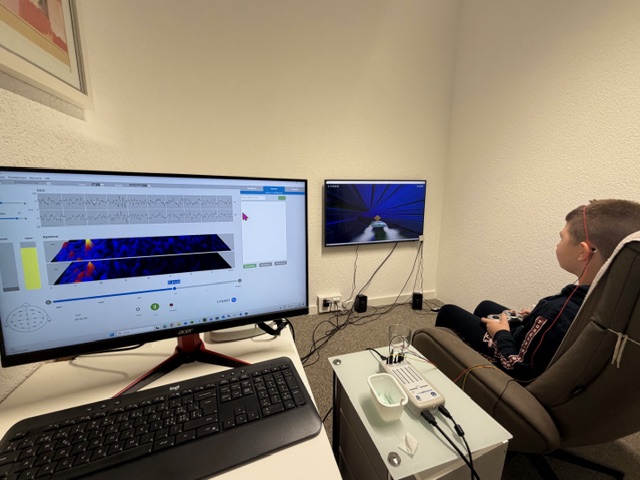
- Therapy: Noah, his parents and his teachers were supported therapeutically, and everyone worked towards the same goals. Noah’s therapy included neurofeedback, a particularly good method for this kind of difference: Noah was able to learn to regulate his emotions better.
What made the difference was not any single building block. What made the difference was that everyone involved had the same picture in mind and was pulling together. For a child who experiences a lot of uncertainty, that is the most important message of all: the adults around me understand me, and they agree with each other.
Today
Today, a relaxed, lovable boy sits across from me. He talks about what he is looking forward to. His mother smiles as he does.

Six months of sticking with it together have given a family its everyday life back.
When I showed Noah’s mother this text, she wrote back:
“We are so glad that you simply offered us your support a few months ago. Now we are finally on a good path. There will be setbacks again, but now we are better prepared and can overcome them.”
What could be better than that?
A story, not a promise
Every child is different, and not every path unfolds like this. But this story shows what becomes possible when diagnostics don’t stop at a label but describe what a child needs, and when family, school and professionals act on it together.
This is exactly what the Biomarker Workshop 2026 on 10 December in Zurich is about.
Names and details have been changed. The family has consented to publication.