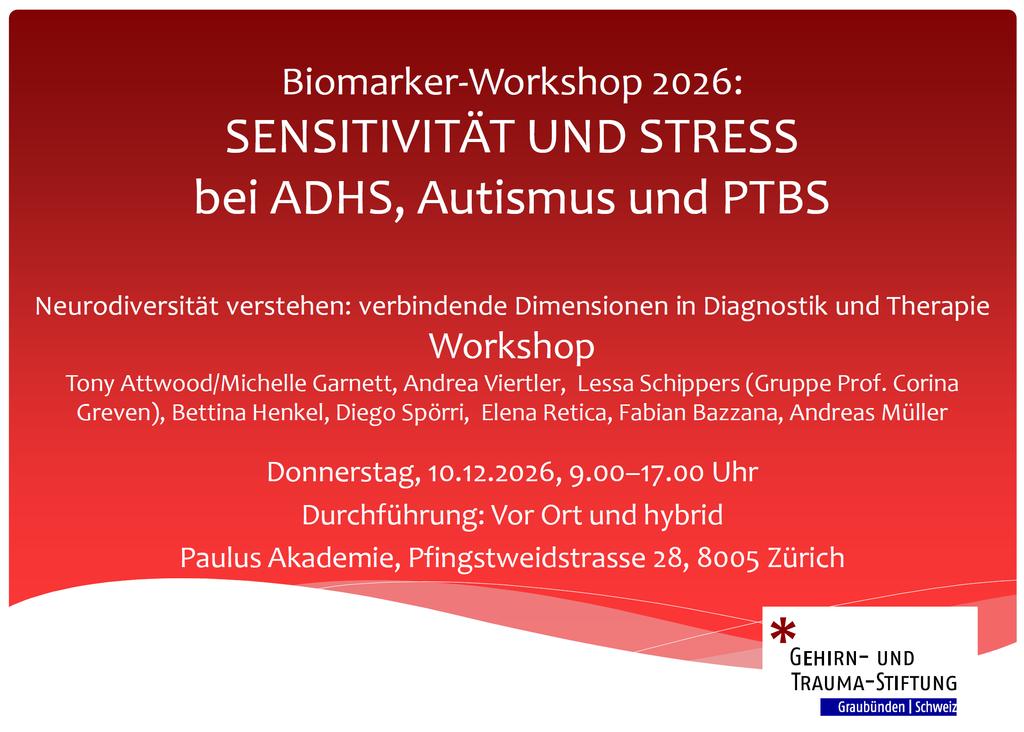
ADHD, autism and PTSD are listed as separate diagnoses. Clinically and neurobiologically, however, they overlap considerably. The 2026 workshop examines the proposition that two dimensions lie beneath these diagnoses: sensitivity — how much a nervous system takes in from its environment and amplifies — and stress — what that intake costs the system.
All three conditions show heightened sensory reactivity, but three different stress profiles: hypoactive, overreactive, sensitised-decoupled. Knowing the profile changes how one intervenes. That is what this day is about.
Keynote
Tony Attwood and Michelle Garnett open the day with the hidden presentations of autism, ADHD and trauma — the pictures that slip through the net because they do not match the stereotypes.
The arc of the day
In seven stations the programme moves from sensitivity as a temperament through stress physiology and the markers of brain function analysis (arousal, vigilance, ERP, entropy) to trauma, coaching and three treatment logics.
Programme
| 9.00 | Welcome: two dimensions beneath the diagnoses |
| 9.15 | Andreas Müller — Sensitivity as temperament: sensory processing sensitivity, genetics, imaging — trait or disorder? |
| 10.00 | Tony Attwood / Michelle Garnett — Hidden presentations: autism, ADHD and trauma beyond the stereotypes |
| 11.00 | Short break |
| 11.15 | Lessa Schippers (Prof. Corina Greven group) — ADHD, autism and sensitivity through a neurodiversity lens: their strengths, struggles and surprising connections |
| 12.00 | Lunch |
| 13.15 | Andrea Viertler — The brain stays in motion. Developmental disorder reconsidered: sensitivity and stress as the engine of change |
| 13.45 | Diego Spörri — ADHD, autism and trauma in paediatric practice |
| 14.15 | Break |
| 14.45 | Elena Retica — From diagnosis to self-understanding: sensitivity, stress and self-regulation in ADHD and autism |
| 15.15 | Fabian Bazzana — Trauma as a problem of sensitivity and stress: findings from the Turin study |
| 16.00 | Bettina Henkel — Three stories, one multi-perspective treatment logic |
| 16.40 | Synthesis and discussion |
| 17.00 | Close |
Speakers
- Prof. Tony Attwood and Michelle Garnett, Australia (video)
- Andrea Viertler, MD, child and adolescent psychiatry, private practice, Berlin
- Lessa Schippers, research group of Prof. Corina Greven, Nijmegen
- Bettina Henkel, MD, adult psychiatry, BrainARC Chur
- Elena Retica, person concerned, mother and ADHD/ASD coach
- Diego Spörri, MD, paediatrician, Lausanne
- Fabian Bazzana, psychologist, head of the PTSD project at the University of Turin
- Andreas Müller, PhD, CEO GTSG, introduction to the topic
Organisation and registration
| Date | Thursday, 10 December 2026, 9.00 a.m. to 5.00 p.m. |
| Venue | Paulus Akademie, Pfingstweidstrasse 28, 8005 Zurich |
| Format | on site and hybrid |
| Fee | CHF 100 per participant |
| Places | 80 in the room (in order of registration), unlimited by video |
| Credits | 7 |
| Language | German; the contributions by Tony Attwood, Michelle Garnett and Lessa Schippers in English |
| Audience | psychiatrists, neurologists, paediatricians, psychotherapists, psychologists, people concerned, parents |
| Registration | registration form · GTSG, Schulstrasse 1, 7302 Landquart, Switzerland · phone +41 81 322 2828 |
Supported by Neurim Pharmaceuticals (gold sponsor), Salmon Pharma (MEDICE), Lundbeck and HBImed.